Introduction
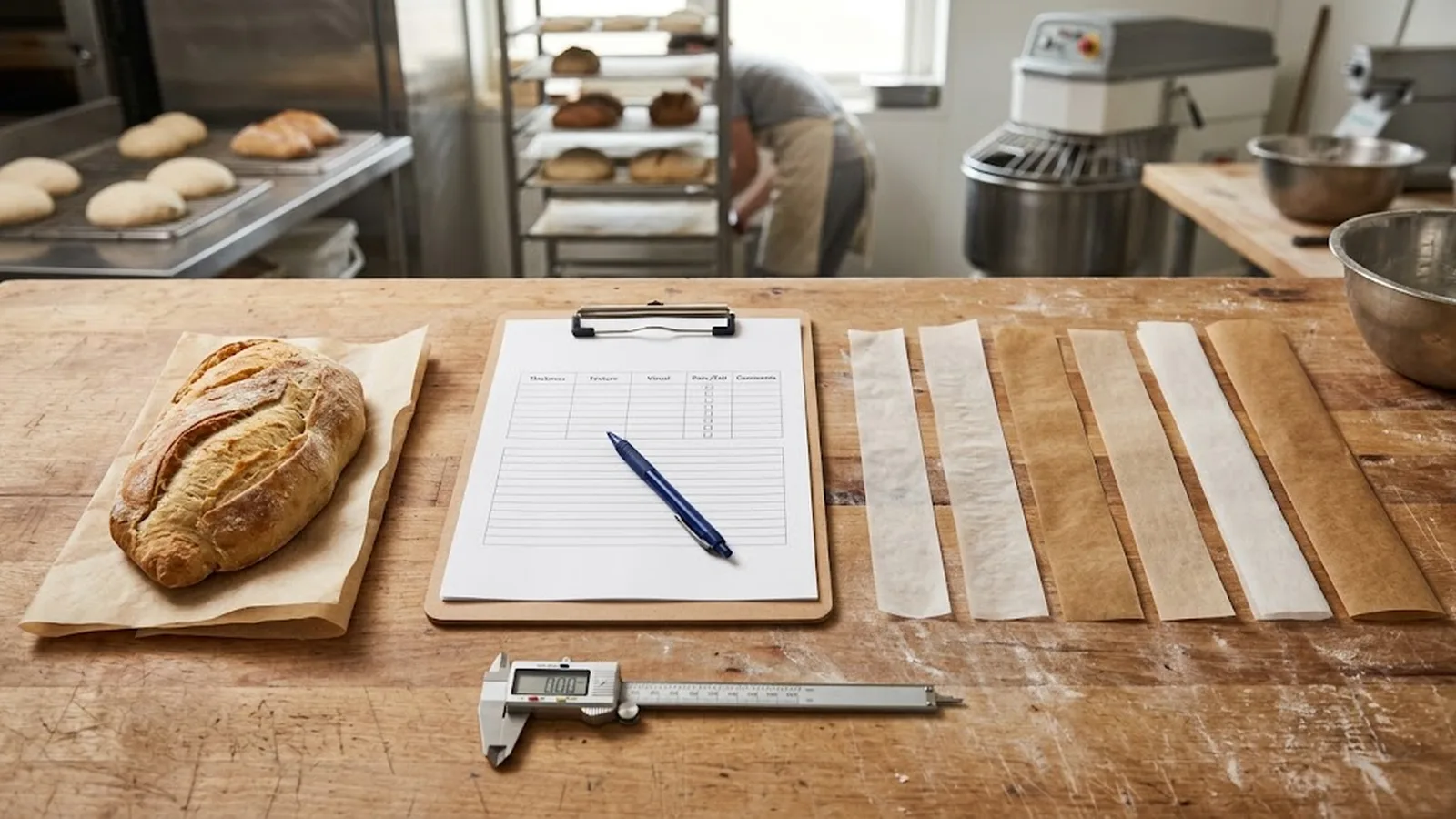
Most baking paper complaints that arrive six months after the first container were visible in the sample box from day one. The sheet that curls at the tray edge, the release that fades after three reuses, the grease bleed on high-fat doughs — all of these are detectable before a purchase order, if the trial is run like an experiment instead of an afternoon of informal baking. The problem is that most buyer trials are unstructured: one sheet, one recipe, one oven, no scoring, no repetition, and no written pass criteria. The result is a decision made on impressions, followed by disputes made on evidence. Buyers comparing these specifications can review our food-grade die-cut parchment rounds programme, where coating weight, base grammage and release values are documented per construction.
This guide gives wholesale buyers a repeatable bake trial protocol: how to plan the sample set, what matrix to bake, how to score release, curl and cycle life, how to document results, and how to convert a passed trial into a signed specification that protects every future lot. Buyers verifying these specifications can review the certificate library alongside supplier documentation requests.
LANGMAI manufactures silicone-coated baking paper for wholesale and private-label buyers and supports structured sample trials. The protocol below works with any supplier and any paper grade.
Plan the Trial Before the Paper Arrives
A trial is only as good as its plan. Before requesting samples, write down: For production volumes, the same construction logic applies to our custom silicone-coated baking parchment paper line, quoted per roll, sheet or die-cut format.
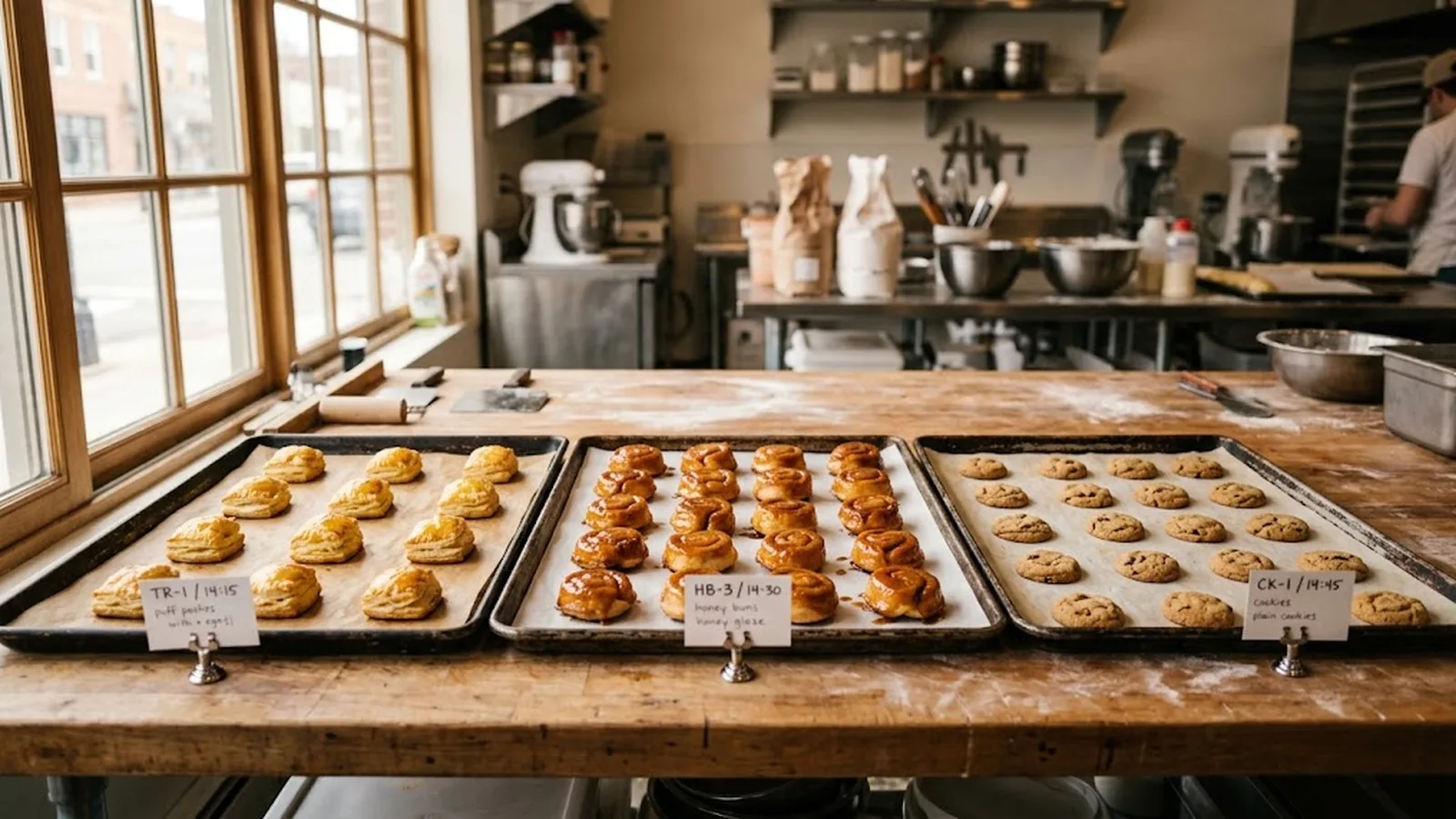
- The products that stress paper hardest. High-fat doughs (brioche, croissant), sticky batters (honey cakes), high-moisture bakes (steamed goods) and long bakes (slow-roasted items) each fail a weak paper in a different way. Test on the extremes of your range, not the average product.
- The equipment profiles. Convection, deck and rotary rack ovens impose different air movement, steam and cycle patterns. If the paper must work in steam, the trial must include a steam cycle.
- The usage model. Single-use or multi-cycle? If your operation reuses sheets, define the reuse pattern now, because cycle life is a pass/fail dimension, not a bonus.
- Pass criteria in advance. Decide what score counts as a pass before baking. Changing the bar after seeing results turns a trial into a rationalization.
Request samples that match the intended specification: correct grammage, coating type (single or double sided), and the sheet or roll format you would actually order. Evaluating a 38 gsm sample for a 45 gsm application proves nothing about the order. The factory and certificate library lists the third-party audits and test reports behind these claims.
Build the Test Matrix
Run the trial as a small grid rather than a single bake. A practical matrix for a bakery operation:
| Test | Product type | What it measures |
|---|---|---|
| Release test | High-fat and sticky recipes | Release quality fresh and after reuse cycles |
| Curl test | Light loads at tray edges | Sheet flatness during and after baking |
| Grease holdout | Butter-rich doughs | Oil bleed-through and staining on trays |
| Steam response | Steamed or steam-oven products | Softening, recovery, post-bake curl |
| Cycle life | Your standard product | Release score per reuse until failure |
| Handling | Full tray load at oven temperature | Tear resistance, edge integrity, operator grip |
Keep one control sheet — your current paper or a known reference grade — through every test, so scores are relative to something real. Mark every sheet with a code rather than trusting memory, because after three cycles identical papers do not look identical.
Score What Matters: Release, Curl, Cycle Life
Three properties decide whether a paper survives production:
- Release. Score each bake on a simple 1 to 5 scale: 5 means the product lifts clean with no residue, 1 means tearing or product loss. Score the stickiest product each cycle; a paper that releases well on cookies but fails on honey dough is a failed paper for your mix.
- Curl and flatness. Note when curl appears (during bake or after cooling), whether it is edge lift or full-sheet curl, and whether it interferes with unloading. Edge curl on light loads is the most common silent failure — it rarely shows in a demo, but it shows every day on the line.
- Cycle life. If sheets are reused, record the release score per cycle and retire the sheet at the first sticking sign. The written cycle limit that comes out of this — for example, "score 4 or better through 6 cycles on cinnamon buns" — becomes your specification and your future receiving benchmark.
Also record practical production signals: tray-to-tray consistency, any odor during bake, staining of the tray surface, and whether operators found the sheet format awkward to load.
Document, Compare, Then Convert to a Specification
A trial that lives in the heads of two bakers cannot defend a supplier decision. Complete the trial with:
- A one-page results sheet per sample: scores per test, photos of representative results, cycle counts and failures.
- The supplier's declared specification next to your observed results — grammage, coating weight, dimensional tolerances, food-contact documentation (for example EU Regulation 1935/2004 and applicable BfR recommendations or FDA compliance for the US market).
- A comparison table across samples, including your current paper as baseline.
When one grade passes, do not stop at an email of congratulations. Convert the result into a signed specification sheet: grade, grammage, coating, format, tolerances, cycle-life expectation, packaging and the documentation set supplied with each lot. Retain sealed reference samples from the approved batch so future deliveries are compared against the standard, not against a memory of a good week.
LANGMAI supports buyers with trial-grade samples matched to declared specifications, full food-contact documentation and retained-sample programs, so the paper that passed the trial is the paper that arrives in every container.
FAQ
How many bake cycles should a baking paper trial include?
Enough to establish the reuse limit your operation will actually apply. For single-use programs, one or two cycles confirm release behavior. For reuse programs, run to failure — commonly five to ten cycles depending on the product — and record the score each cycle. The purpose is a written cycle limit, not a vague "it lasted a while."
Should I trial baking paper on my best-selling product or the hardest one?
Both, but weight the decision toward the hardest. Papers fail at their stress point: sticky, high-fat or steam-heavy products expose weaknesses that neutral products never touch. Include the volume driver product too, because cycle economics are decided by the product you bake most, while complaints are generated by the product you bake least favorably.
What documentation should come with baking paper samples?
A declared specification sheet with grammage, coating type and tolerances, plus food-contact evidence: a declaration of compliance referencing EU Regulation 1935/2004 and relevant BfR recommendations for Europe, or FDA food-contact requirements for the US market. Samples without documentation should not be trialed at all, because a passing trial on undocumented paper cannot be converted into a safe repeat order.
Does LANGMAI provide samples for structured bake trials?
Yes. LANGMAI supplies trial samples matched to the buyer's declared grammage, coating and format, supports multi-cycle trial programs with written pass criteria, and manufactures to the signed specification for wholesale and private-label programs. Контакты Sales with your product mix and oven profiles for a matched sample set.
Conclusion
A bake trial is the cheapest insurance a paper buyer can buy, but only if it is run as an experiment: planned extremes, a written matrix, scored results against a control, and a specification signed at the end. The alternative — a loose demo followed by a container order — trades one sample round for months of line complaints. Structure the trial once, and every future supplier comparison becomes faster, fairer and defensible. Our wholesale parchment paper rolls and sheets programme publishes the test data behind each grade so specifications can be verified before ordering.
CTA
Контакты Sales for LANGMAI baking paper trial samples, declared specifications and food-contact documentation matched to your products, ovens and cycle-life targets, including wholesale and private-label quotation.