
Introduction
Grammage tells you how much fiber a baking paper sheet contains; tensile strength tells you whether that fiber survives wet dough, hot fat and mechanical handling. Two 40 gsm sheets with identical basis weight can differ by 40 percent in the force they absorb before tearing — and the difference only shows up at the worst moment: a wet croissant dough lugged across a bench, a liner dragged from under a sticky crumb, a roll fed through a dispensing box in a hurry. Buyers who specify grammage alone routinely receive paper that measures on spec and still fails in use. Buyers comparing these specifications can review our private-label parchment paper supplier programme, where coating weight, base grammage and release values are documented per construction.
This guide explains how tensile strength works in baking paper, why wet strength predicts field performance, how strength requirements map to applications, and how to write strength into a specification a supplier can guarantee and a receiving dock can verify. Buyers verifying these specifications can review the certificate library alongside supplier documentation requests.
1. Tensile Strength Basics: MD, CD and What the Numbers Mean
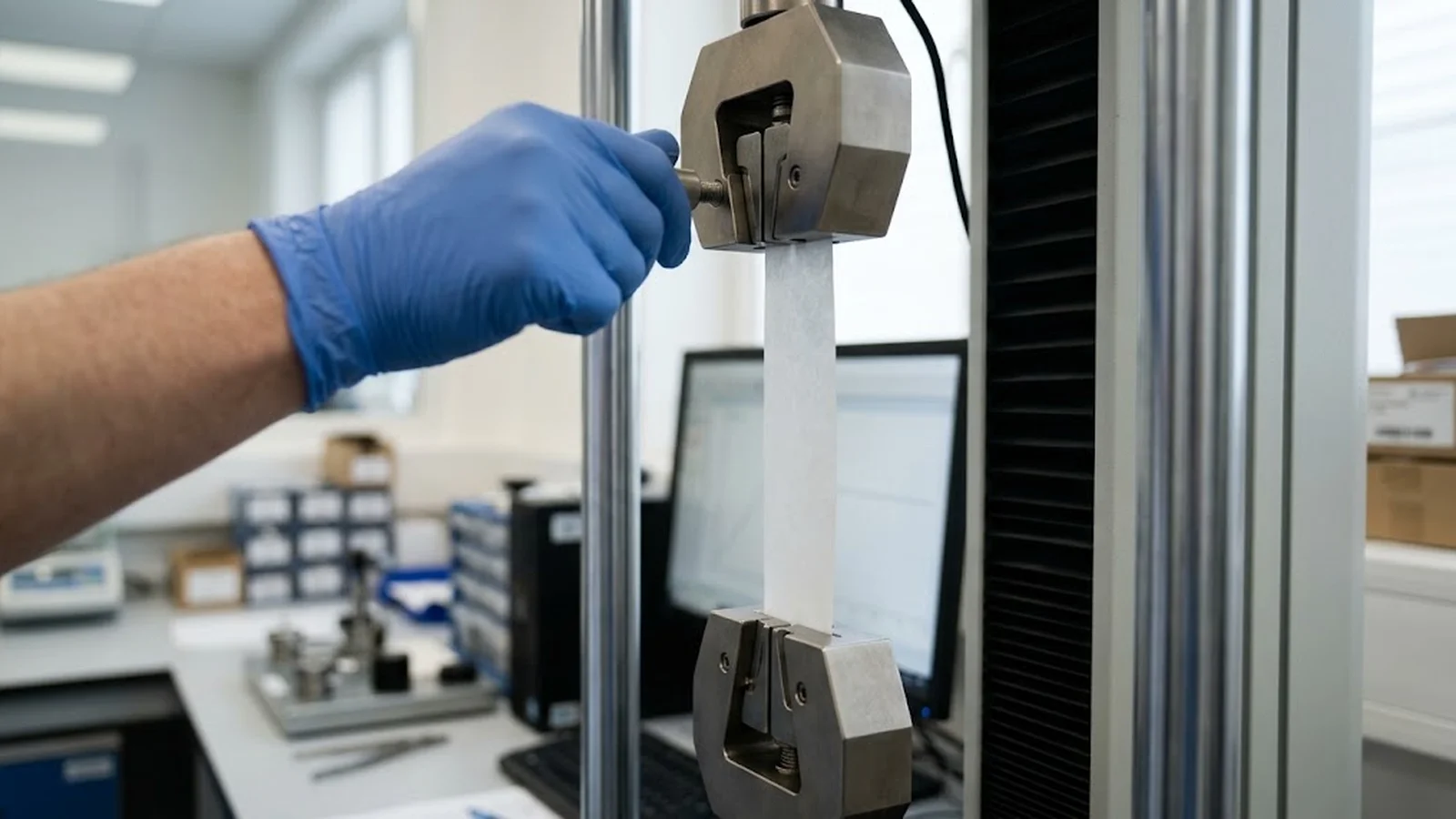
Tensile strength measures the force a paper strip absorbs before breaking, in kN/m. Because paper is made on a moving machine, its fibers align predominantly in the machine direction (MD) — the direction the web travels. Cross direction (CD) strength is therefore always lower, typically 40–60 percent of MD. Every credible test report states both. For production volumes, the same construction logic applies to our pre-cut parchment paper sheets and rounds line, quoted per roll, sheet or die-cut format.
For buyers, the translation is simple: the CD value governs real-world failure. When a baker pulls a liner sideways off a tray or tears a sheet from a roll against its length, the load lands in the cross direction. A supplier quoting only MD tensile is quoting the flattering number. The factory and certificate library lists the third-party audits and test reports behind these claims.
Reference bands for silicone-coated baking parchment, useful as starting points rather than fixed law:
- Dry MD tensile: roughly 3.5–5.5 kN/m at 38–45 gsm.
- Dry CD tensile: roughly 1.8–3.0 kN/m at the same weights.
- Elongation at break: 3–8 percent CD; papers with very low elongation tear suddenly under an uneven load.
Strength rises with grammage but not linearly with price — a well-refined 38 gsm sheet can outperform a poorly refined 45 gsm sheet. Tensile measures the quality of fiber processing, not just the quantity of paper, which is why it belongs in the specification.
2. Wet Strength: The Number That Predicts Field Failure
Dry tensile is measured in a conditioning room at 23°C and 50 percent humidity. Commercial baking is neither. Contact with wet dough, egg wash, fruit purée or hot butter partially floods the hydrogen bonds that give dry paper its strength, and an untreated sheet can lose 80–95 percent of its strength when saturated — which is why plain paper disintegrates when you lift a wet liner.
Baking parchment resists this in two ways: the silicone release coating repels water and fat at the surface, and internal wet-strength resins (added at stock preparation) permanently crosslink a portion of the fiber bonds so the sheet retains structure when soaked. A production-grade baking paper should retain roughly 15–30 percent of its dry tensile after full saturation — enough to lift a wet liner off a tray without it falling apart.
The standardized measure is wet tensile strength, tested after controlled immersion (per ISO 3781 or TAPPI T 456), in the same kN/m units. Two specification traps to avoid:
- "Wet strength" claimed without a number. Ask for the retained-strength percentage or the wet kN/m value. A marketing claim is not a parameter.
- Wet strength that depends on coating alone. Some economy papers achieve acceptable wet behavior through heavy silicone only; scratch or abrade the coating and the sheet fails. Internal wet-strength treatment is what keeps performance after the surface is damaged — which it will be, in a commercial bakery.
3. Matching Strength Requirements to the Application
Not every application needs maximum strength, and over-specifying costs money per tonne. Three practical tiers:
- Light contact — cookie lines, tray liners under dry batters. Dry tensile within the standard band and a competent silicone coating carry the application; wet exposure is minimal and momentary. The failure mode is more often coating transfer than tearing.
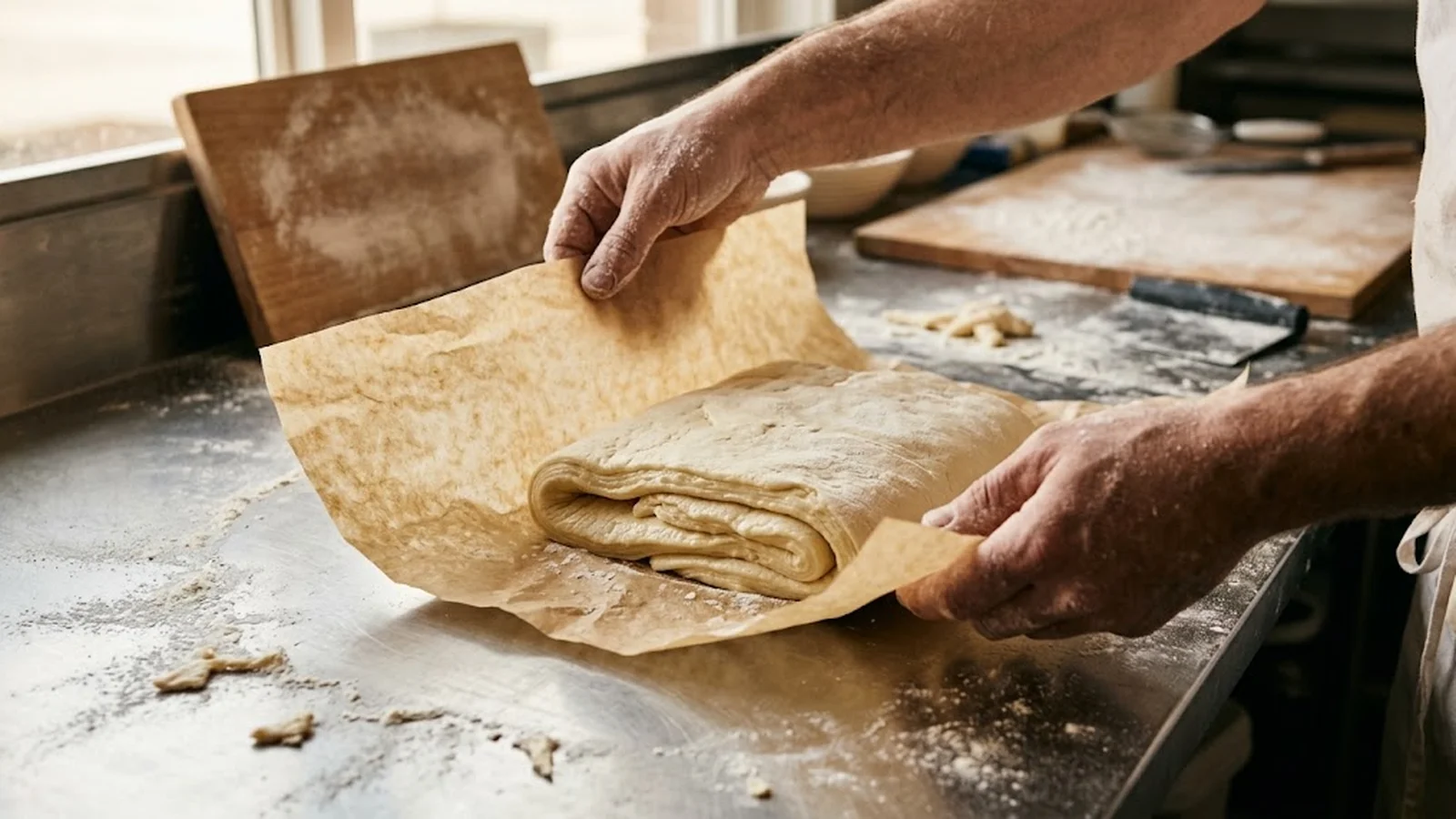
- Wet and fatty contact — croissant and laminated dough, high-hydration breads, sticky fruit batters. This is where wet tensile earns its place in the spec. Dough sheets are heavy when wet, dragged and repositioned, and saturated edges are routine. Specify wet tensile explicitly and validate with a soak test: immerse a sample for 60 seconds, then lift a 500 g wet dough ball on the sheet.
- Roll formats in dispensing boxes. Tensile interacts with tear-off performance: a roll too strong in MD resists tearing at the perforation, while too-low CD strength produces ragged, off-line tears. If you buy rolls, add a tear-off linearity check to the approval protocol.
High-hydration and frozen-dough programs sit in the most demanding corner: frozen dough thaws against the paper, releasing water on a schedule, and the liner must hold both cold and wet. Flatness behavior is a separate specification, but the strength requirement is separate too and should be written separately.
4. Verifying Strength in Samples and Shipments
Strength is measurable on arrival with modest equipment, and it should be measured, because refining and resin additivity drift in production. A workable incoming protocol:
- Sample across the lot — pull sheets from several cartons and pallet positions.
- Cut test strips — 15 mm wide, five in MD and five in CD, conditioned briefly at room humidity.
- Test with a tensile tester if you have access to one (or through a local third-party lab quarterly); otherwise use the comparative discipline test: wet a strip, hang it with a 300 g weight clipped to the lower end, and confirm it holds for 30 seconds.
- Record the extremes, not the average, and compare against the approved sample as well as the spec sheet.
- Run the application check — the bench test with your actual wettest product — at every supplier change and annually thereafter.
Reasonable tolerance bands for the specification: dry tensile ±15 percent from the approved reference, wet strength retention minimum 15 percent of dry, stated in both MD and CD. Buyers who log tensile alongside grammage and thickness build the trend data that catches drift before the complaint call does.
FAQ
What tensile strength should baking paper have for commercial use?
For silicone-coated baking parchment at typical 38–45 gsm weights, expect dry tensile around 3.5–5.5 kN/m in the machine direction and 1.8–3.0 kN/m in cross direction. The CD value matters most for real handling, so require both numbers in the specification and tie them to the approved sample.
Does wet strength matter if the paper is silicone coated?
Yes. Silicone coating repels water at the surface but does nothing once the paper is cut, scratched or soaked at the edges — and in commercial use edges soak constantly. Internal wet-strength treatment keeps the sheet intact when saturated; a production-grade baking paper should retain roughly 15–30 percent of its dry strength when wet.
How do I test baking paper strength without a lab?
Use a comparative discipline test. Cut identical strips from your approved sample and from the incoming shipment, wet them for 60 seconds, hang each with a 300 g weight, and compare holding time. It will not replace a tensile tester for contract disputes, but it catches gross strength failures in ten minutes on the receiving dock.
Conclusion
Tensile and wet strength decide whether baking paper behaves in the bakery or only in the brochure. Specify both MD and CD dry tensile against the approved sample, write a numeric wet-strength requirement instead of accepting a claim, match the strength tier to the application, and verify on arrival with a repeatable protocol. Strength that is written down, measured and trended is the difference between a specification and a hope. Our custom printed baking parchment paper programme publishes the test data behind each grade so specifications can be verified before ordering.
CTA
LANGMAI manufactures silicone-coated baking paper with MD/CD tensile and wet-strength values written into every specification and verified by multi-bake and soak testing. Contact our wholesale team with your application — dough weights, hydration levels and handling conditions — for matched samples and a strength-validated quotation.
Sources
- ISO 1924 — Paper and board: determination of tensile properties
- ISO 3781 — Paper and board: determination of tensile strength after immersion in water
- TAPPI — Technical resources for pulp and paper testing
- FDA — 21 CFR Part 176 Indirect Food Additives: Paper and Paperboard Components
- EU Regulation 1935/2004 — Materials and articles intended to come into contact with food