Introduction
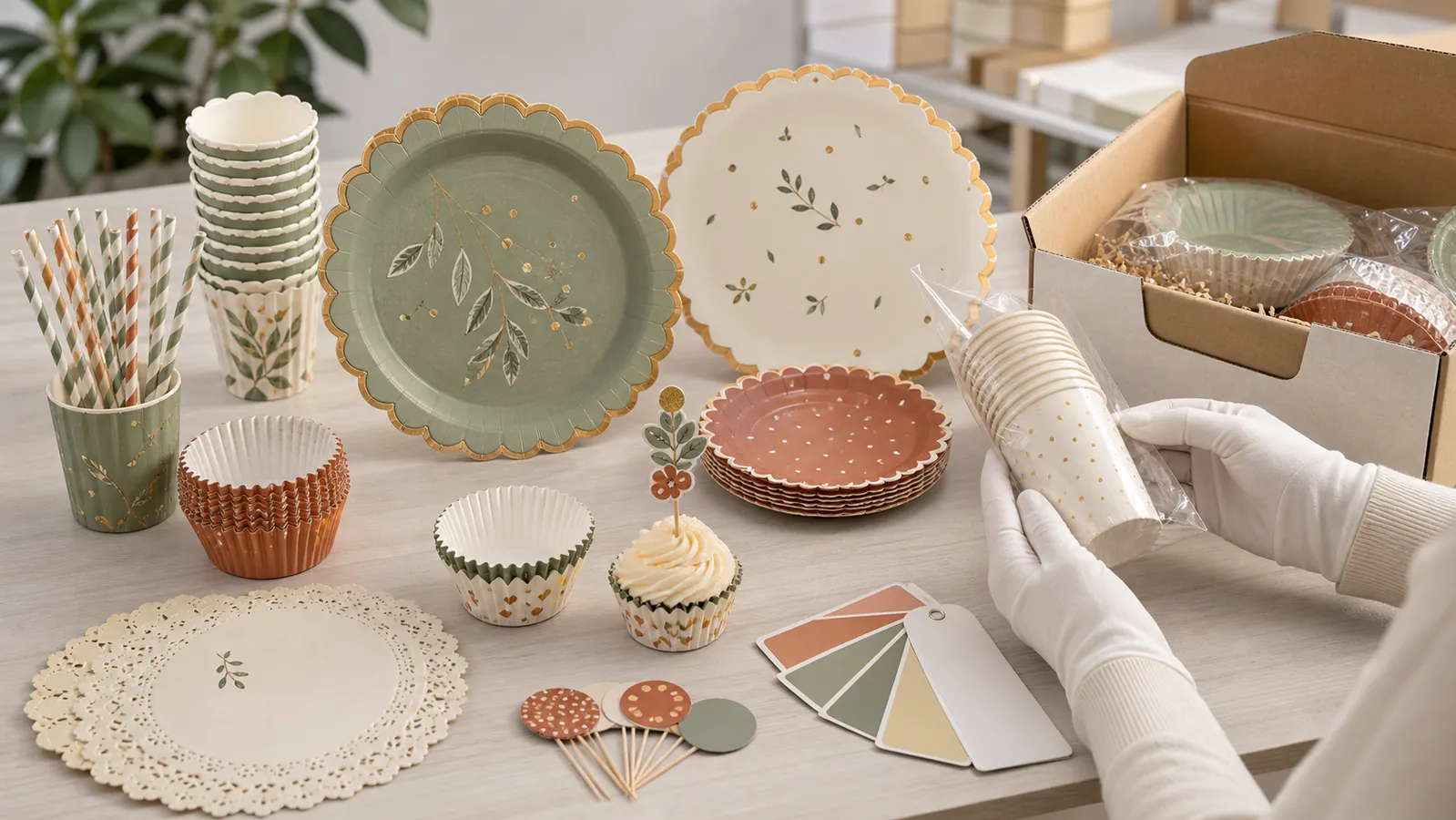
The best way to source party paper supplies wholesale is to plan a range as a connected SKU system, not as a collection of isolated designs. Start with the sales channel and occasions you intend to serve. Choose a small set of anchor products, define a shared design system, separate food-contact articles from decorative accessories, and lock pack counts and carton configurations before approving artwork. Then review a physical sample set as a complete range and inspect assortment, colour, count, packaging and carton details before shipment.
This approach matters because a birthday collection can include products with very different functions. Cupcake liners, plates, cups and straws may contact food. Toppers, banners, picks, doilies and cake boards may have different contact conditions or may be decorative only. Retail packs need scannable identification and accurate counts, while ecommerce packs also need to survive parcel handling and arrive presentable. One attractive pattern cannot resolve all of those buying decisions.
This guide is for importers, distributors, private-label teams, supermarkets, ecommerce sellers and event-supply wholesalers. It explains how to turn a theme idea into a quote-ready assortment, compare suppliers on evidence, approve samples efficiently and protect repeat-order consistency.
1. Define the Commercial Job of the Range
Before choosing colours, decide where and how the assortment will sell. The same products can require different configurations in different channels.
| Channel | Buyer priority | Practical range implication |
|---|---|---|
| Supermarket or homeware retail | Shelf clarity, price tiers, barcodes, replenishment | Fewer core themes, clear pack counts and shelf-ready case planning |
| Ecommerce marketplace | Searchable themes, parcel durability, image accuracy | Compact packs, protective outer packaging and consistent product photography |
| Event-supply wholesale | Broad choice, mixed orders, reliable reordering | Modular themes and products that can be ordered separately |
| Bakery or foodservice | Functional food-contact items and service packs | Emphasise cups, liners, straws and practical bulk configurations |
| Seasonal promotion | Fast theme recognition and planned exit stock | Tight launch calendar, conservative SKU count and clear reorder cut-off |
Next, define an occasion architecture. A useful first range might contain evergreen birthday colours, one or two age-neutral celebration themes and a limited number of seasonal capsules. Every extra colour, count or design adds artwork, samples, item records and inventory, so a narrower launch can produce better reorder evidence.
2. Build the Range Around Anchor SKUs
Anchor SKUs are the items customers understand immediately and are likely to search for or add first. For a paper party range, possible anchors include coordinated plates or cups, cupcake liners, paper straws or a defined table set. Accessories then extend the basket without carrying the whole commercial proposition.
LANGMAI's published range includes paper party accessories for retail and event supply, with birthday and seasonal themes, mixed party sets, custom patterns and retail-pack support. Its application pages also describe combinations of themed cups, toppers, straws, cake boards and disposable tableware. Buyers should still confirm which exact products, materials and production routes are available for the proposed program rather than assuming that every item is made on the same line.
A practical assortment can be mapped like this:
| Range role | Example products | Decision to lock |
|---|---|---|
| Anchor | Plates, cups, cupcake liners or table set | Main colour, theme, size and consumer pack count |
| Functional add-on | Paper straws, napkin-compatible accessories, cake boards | Intended use, dimensions, food-contact status and pack protection |
| Decorative add-on | Toppers, picks, banners or doilies | Material, edge finish, assembly and age-positioning review |
| Basket builder | Coordinated mixed set | Exact contents, substitution rules and component counts |
| Reorder core | Plain or evergreen colourways | Repeatability, retained artwork and material reference |
Mark whether each SKU is sold alone, used in a set, or both. Different configurations need separate bills of materials and packing instructions even when a component is identical.
3. Use a Range Matrix Before Requesting Samples
A range matrix is the buyer's control document. It prevents a supplier from quoting from a mood board while the buyer assumes that all commercial details are already understood.
Include these fields for every proposed SKU:
- Internal SKU name and working description
- Theme, base colour and accent colours
- Product type, dimensions and material
- Intended use and whether food contact is expected
- Consumer pack count and inner-pack arrangement
- Retail, ecommerce or service channel
- Artwork version and print area
- Barcode or GTIN owner and placement
- Required market, language and label content
- Sample status and approval date
- Case quantity, carton marks and pallet preference
- Reorder priority and planned launch window
> Planning a coordinated collection? Review LANGMAI's paper party accessories and OEM customization workflow, then send one range matrix rather than separate, incomplete SKU requests.
4. Control Artwork and Colour Across Different Materials
A coordinated range should look related, but identical digital colour values do not guarantee identical physical colour. White greaseproof paper, kraft paper, coated board and absorbent decorative paper reflect light and accept ink differently. Forming, varnish, print method and the colour of the base material can also change the result.
Set a hierarchy instead of demanding an undefined "perfect match":
- Identify the hero colour or motif that must be recognisable across the collection.
- Define which SKU is the visual master, such as the plate or retail box.
- Approve substrate-specific colour targets where an exact match is not realistic.
- Review all samples together under consistent lighting.
- Record approved artwork versions and retain signed or otherwise clearly approved references.
Check more than the front-facing design. Review registration, cut alignment, pattern direction, rub resistance, set-off between stacked pieces and odour after enclosure. Agree the acceptance method for the actual substrate and use. For mixed sets, link every artwork file to the correct product and pack position.
5. Separate Food-Contato Review from Decorative-Product Review
Party assortments often combine articles with different regulatory questions. Treating the whole set as "food safe" or "non-food" is too broad.
For the European Union, materials and articles intended to contact food must comply with Regulation (EC) No 1935/2004, and food-contact manufacturing is also subject to good manufacturing practice requirements. The European Commission notes that the framework covers safety and inertness, labelling, compliance documentation and traceability. It also explains that paper does not have a single fully harmonised EU-specific measure, so relevant national rules may also need review. Buyers should start with the Commission's food-contact materials overview and legislation page, then confirm requirements for the destination country and exact use.
In the United States, the regulatory status of each food-contact component depends on its identity and intended conditions of use. FDA points buyers to 21 CFR Parts 174–179, including Part 176 for paper and paperboard components, and explains that other clearances or exemptions can also be relevant. Use FDA's food-contact component status guidance as a starting point rather than treating an "FDA" statement as a universal finished-product approval.
For each food-contact SKU, connect documents to the exact base paper, coating, ink, adhesive and finished construction; intended food and contact side; contact time and temperature; destination market; tested article; report date; and report scope.
Decorative items need their own assessment. An item marketed primarily to children, a kit containing small components, or a decorated consumer product may raise questions that do not apply to a general-use seasonal decoration. CPSC guidance explains that decoration and marketing can affect whether a product is considered a children's product, while many seasonal decorations remain general-use products. Review the exact product and positioning using CPSC's promotional-products guidance and children's-products guidance, and obtain specialist advice where classification is unclear.
For non-food consumer products sold in the EU, the General Product Safety Regulation has applied since 13 December 2024. Scope and obligations depend on the product and economic operator, including online sales. The European Commission's GPSR overview is the appropriate current starting point.
6. Engineer the Retail Pack and Logistics Hierarchy
Retail packaging is part of the product specification. A strong assortment can still fail if counts are unclear, barcodes do not scan or case configurations do not match retailer data.
Lock these details before production:
- Exact contents and count visible to the customer
- Primary pack format, closure and product visibility
- Label copy, language, responsible-party information and any warnings required for the market
- Barcode quiet zone, contrast, orientation and final placement
- Inner-pack and master-carton quantities
- Carton dimensions, gross weight targets and marks
- Case purpose, pallet pattern, moisture protection and mixed-SKU rules
GS1's GTIN Management Standard distinguishes trade items across packaging levels, and its pack/case quantity rule states that changing the number of trade items in a case or cases in a predefined pallet configuration requires a new GTIN at affected higher packaging levels. The brand owner should therefore establish item identification and case hierarchy before packaging is printed, not ask the factory to invent a retail barcode.
For EU programs, packaging planning should also account for Regulation (EU) 2025/40 on packaging and packaging waste. The European Commission states that it entered into force on 11 February 2025 and generally applies from 12 August 2026. It covers packaging regardless of material or origin and includes requirements on manufacturing, composition and recoverability or reuse. Buyers should review the Commission's current packaging-waste and PPWR overview and confirm the obligations that apply to their role, packaging format and market.
Avoid unsupported claims such as "plastic-free," "recyclable everywhere," "biodegradable" or "compostable" unless the exact construction, test basis and destination-market communication support them. A paper outer box does not make every component in a mixed set equivalent.
7. Approve the Full Set, Not Only Individual Samples
Individual samples show whether one item can be made; a range review shows whether the collection can be sold together. Ask for the intended consumer packaging and document the following checks.
Product and use checks
- Confirm dimensions, shape, count and components against the matrix.
- Test food-contact items under buyer-defined use conditions.
- Check fit with complementary products and review decorative-item edges, points, loose components and assembly.
Visual range checks
- Review the collection in a mock shelf arrangement under consistent lighting.
- Photograph the approved set and confirm ecommerce images represent the real samples.
- Check whether pack fronts communicate theme, count and product type at thumbnail size.
Packaging and handling checks
- Count mixed-pack components and prohibit substitutions unless approved.
- Verify barcodes and simulate parcel or case handling for the sales channel.
- Inspect for abrasion, crushed edges, movement, moisture risk and loose inserts.
Record approvals by SKU and artwork version. A verbal "the set looks good" is not a production instruction.
8. Compare Suppliers with an Evidence-Based Scorecard
Price comparison is meaningful only after suppliers quote the same range definition. Use a scorecard that reflects commercial risk.
| Evaluation area | Evidence to request | Warning sign |
|---|---|---|
| Range capability | Product list, material routes and sample examples relevant to your matrix | Agreement to every item without clarifying production source or limitations |
| Artwork control | File naming, proof route and retained approval method | Multiple versions shared through chat with no final reference |
| Food-contact support | Documents tied to exact materials, use and market | Certificate names with no scope connection to the SKU |
| Mixed-set packing | Bill of materials, count control and packing sequence | Manual substitutions allowed without written buyer approval |
| Retail packaging | Dieline, label checklist, barcode placement and case plan | Packaging discussed only after product approval |
| Quality control | Agreed checks based on buyer specifications and approved samples | Generic "high quality" promise with no acceptance method |
| Repeat orders | Artwork, material and packing records linked to SKU | No change-control method for materials or pack components |
LANGMAI's local site describes OEM/ODM customization, sampling, carton confirmation and shipment inspection. A buyer should still agree the exact scope for the proposed party range, including which checks are performed by the factory, which are performed by the buyer or a third party, and what evidence is required before shipment release.
9. Send a Quote-Ready RFQ
A strong RFQ reduces rounds of clarification and makes supplier quotations easier to compare. Include:
- The completed range matrix and priority SKUs.
- Product dimensions, materials and intended uses.
- Target markets, food-contact conditions and customer standards.
- Artwork status, colour references and print coverage.
- Consumer pack counts, mixed-set bill of materials and substitution rules.
- Label languages, barcode ownership and placement requirements.
- Inner, case and pallet configuration preferences.
- Sample quantities needed for buyer, laboratory or customer review.
- Target launch window and requested production milestones.
- Inspection criteria, required shipment photos and release responsibility.
Ask suppliers to separate tooling, sampling, product, retail packaging and logistics assumptions where relevant. Do not lock a launch date until sample approval, document review and production timing are reconciled.
10. Pre-Shipment Checks for a Coordinated Party Range
Before release, inspect against the approved range matrix and samples. Set the plan from order size, product risk and customer requirements rather than copying an arbitrary fixed AQL value.
Verify at minimum:
- Correct SKU, artwork revision, colourway and pack count
- Component identity and absence of unapproved substitutions
- Product dimensions and appearance against approved references
- Packaging closure, labels, barcodes and market copy
- Inner and master-carton quantities
- Carton marks, assortment ratios and pallet configuration
- Cleanliness, odour and visible damage appropriate to the product
- Traceability identifiers and supporting documents agreed for the shipment
- Random packed-set opening to confirm contents, not only outer labels
For mixed assortments, reconcile component totals with the number of sellable sets before cartons are sealed. One missing low-cost component can block an otherwise finished kit.
FAQ
What should be included in a first wholesale party paper range?
Start with a limited number of anchor items, such as plates, cups, cupcake liners or paper straws, then add a few coordinated decorations or mixed sets. Select products based on channel and occasion demand, not only on how many designs a supplier can show.
How can buyers keep colours consistent across party products?
Choose a visual master, define key colour references, approve substrate-specific targets and review the complete physical sample set under consistent lighting. Exact matches may not be realistic across different papers, coatings and print methods.
Do all paper party supplies need food-contact documentation?
No. The need depends on whether the item is intended or reasonably expected to contact food, its construction, conditions of use and destination market. Review food-contact items individually and do not extend one report to unrelated decorative products.
Who should provide the retail barcode?
The brand owner normally controls GTIN allocation and should provide or approve barcode data. The supplier can place approved artwork, but should not invent identification numbers or reuse another product's code.
Should a mixed party set have its own sample approval?
Yes. Approve both individual components and the final packed set. The set review should cover exact contents, count, arrangement, label copy, barcode, pack durability and visual coordination.
How should importers compare wholesale party suppliers?
Compare suppliers against the same range matrix and score evidence for artwork control, material and document scope, mixed-set packing, retail packaging, quality checks and repeat-order change control. Unit price alone does not show these risks.
What information should a party-supplies RFQ include?
Include the SKU matrix, dimensions, materials, intended use, target markets, artwork, pack counts, label and barcode requirements, carton configuration, sample plan, launch timing and inspection expectations.
Conclusion
Successful party paper sourcing starts with assortment architecture. Define the channel and occasion, control range size with anchor SKUs, document variants and approve the collection as a physical retail system. Keep food-contact and decorative-product reviews separate, assign packaging and GTIN responsibilities early, and release shipments against approved product, artwork and packing records.
LANGMAI supports paper party accessories, coordinated themes and custom retail-pack discussions alongside cupcake liners, paper straws and related food-paper products. Availability, document scope and production route should be confirmed for every proposed SKU.
Request a Party Range Quotation
Ready to compare a coordinated collection? Send your target products, themes, dimensions, pack counts, markets, quantity and artwork status through the LANGMAI inquiry form. The team can review available product and customization routes and discuss a practical sampling sequence before quotation.