Introduction
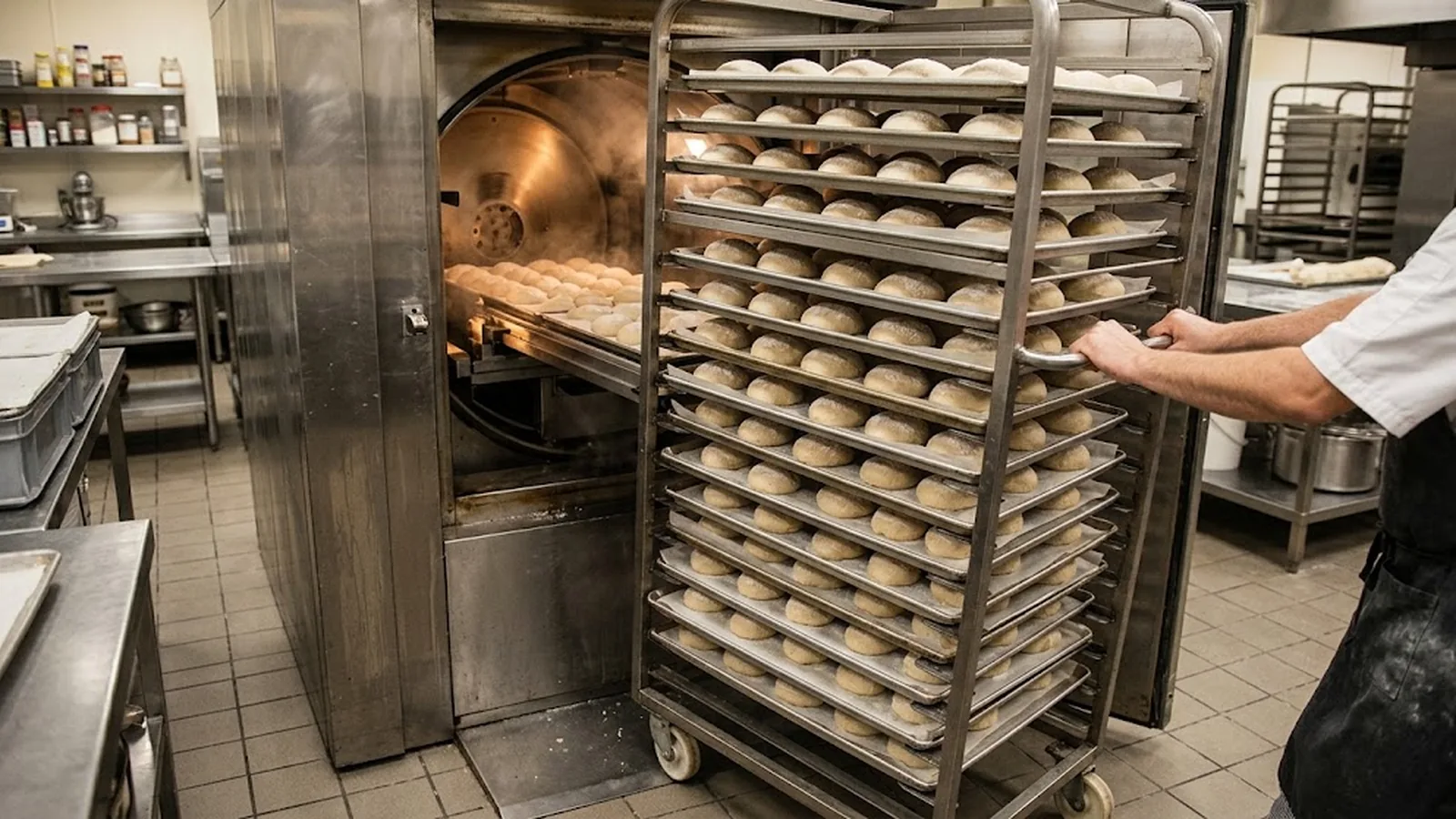
Rotary rack ovens are the workhorse of retail, hotel and mid-size industrial bakeries: a full rack of trays rotates inside a chamber, the load bakes in a single batch, and steam injection opens the crust on breads and rolls. That combination creates a distinct environment for baking paper. The sheet sees high humidity early in the bake, radiant heat from the chamber walls, and repeated warm-to-cool cycles as the rack is wheeled out, unloaded and loaded again. Papers chosen for deck ovens or tunnel lines do not always translate, and buyers who specify by price alone often discover curling corners, sticking bottoms and discolored sheets halfway through a production morning. Buyers comparing these specifications can review our food-grade die-cut parchment rounds programme, where coating weight, base grammage and release values are documented per construction.
This guide is written for bakery operations, purchasing teams and private-label buyers who run rotary rack ovens and need to specify baking paper that survives real rack service: which formats fit rack baking, how steam and cycling change paper behavior, what to verify in samples and documents, and how to compare suppliers on total cost per bake rather than on price per sheet. Buyers verifying these specifications can review the certificate library alongside supplier documentation requests.
LANGMAI supplies silicone-coated baking paper and related food-paper products to wholesale and industrial buyers, and quotes against buyer specifications. The guidance below is supplier-neutral so it can structure evaluations with any candidate.
What Makes Rotary Rack Service Different
Three characteristics set rotary rack ovens apart from other baking environments: For production volumes, the same construction logic applies to our custom silicone-coated baking parchment paper line, quoted per roll, sheet or die-cut format.
- Steam injection. Most rack ovens inject steam at the start of the bake for breads, rolls and viennoiserie. Early humidity softens the paper, and a grade that dries and stiffens cleanly after the steam phase will outperform one that stays limp, curls onto the product, or transfers moisture to the crust bottom.
- Cyclic batch use. Unlike a tunnel line, a rack oven runs discrete batches. Sheets may be changed every batch, reused for a defined number of cycles, or left on the tray between runs. Each policy has different requirements for release stability and browning limits.
- Mixed loads. A single rack often carries bread on some trays, danishes on others and cookies elsewhere. Buyers frequently standardize on one or two grades for the whole oven, so the chosen paper must perform across high-sugar, high-fat and lean-dough products, or the program needs a deliberate two-grade plan.
Because of this, a specification built only on "oven-safe to a temperature" is incomplete. Steam behavior and cycle life decide daily performance. The factory and certificate library lists the third-party audits and test reports behind these claims.
Define Your Program Before Comparing Suppliers
Before requesting samples, document the operating picture:
- Oven profile: chamber temperature setpoints, steam injection timing and duration, rack rotation speed, and typical bake times per product family.
- Tray and loading pattern: full-sheet pan dimensions, product coverage per tray, whether trays are lined edge to edge or with strips, and trays per rack.
- Re-use policy: single use per batch, or a defined number of cycles with retirement criteria.
- Product mix: the share of high-sugar items (sticky bottoms), high-fat items (release stress), and lean doughs (steam exposure).
- Downstream handling: whether the paper leaves the bakery with the product (customer-visible presentation) or stays in-house (cost and reuse dominate).
This one-page operating summary lets every supplier propose against the same reality, and it becomes the checklist for the sample trial.
Paper Properties That Matter Most in Rack Ovens
Steam response and curl behavior
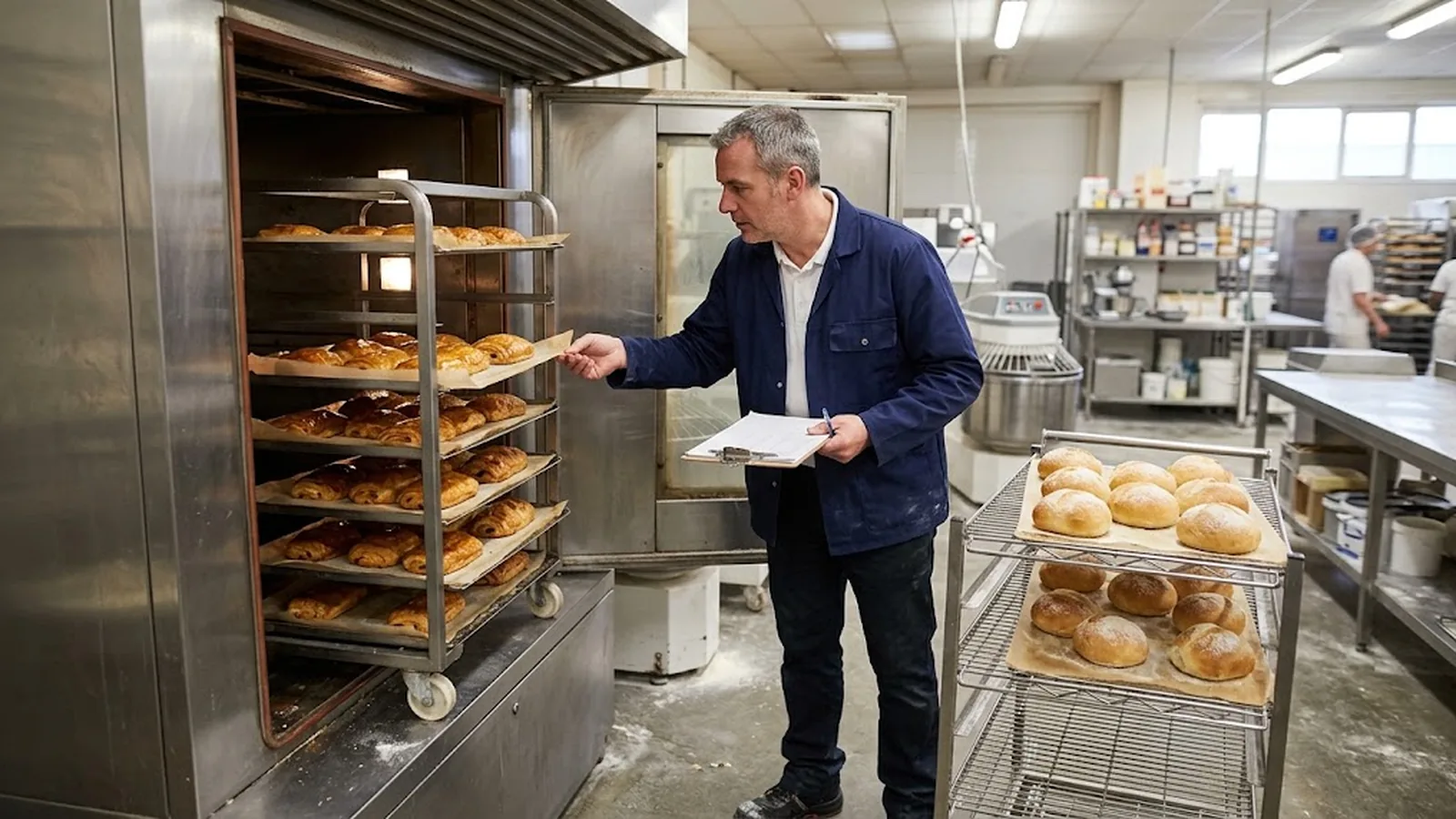
Ask each candidate how the grade behaves after steam exposure and subsequent drying. In trials, line trays for a bread load and a viennoiserie load, and record curl direction and magnitude at tray exit, after cooling, and after the sheet dries fully. A sheet that curls upward at the corners in a hot, humid chamber can lift product edges and produce uneven crust color on the underside.
Release stability across cycles
If you reuse sheets, release force must hold from the first bake to the last. Score release after every cycle on the stickiest product in your mix, and define a written retirement point, for example the cycle at which any sticking appears. Sheets pushed past their release life slow the unloading team down long before the cost saving shows up.
Browning under repeated exposure
Rack ovens can brown paper faster than expected because the chamber radiates from the walls during rotation. Record edge and face color per batch on a simple scale and compare candidates after the same number of cycles. Visible browning matters more when the paper is customer-facing; in-house use tolerates more color if release and strength hold.
Wet and hot tensile strength
A limp, steam-softened sheet must still survive tray handling. Check tear behavior when the paper is warm and slightly damp, especially at the corners operators grip during unloading.
Formats and Supply Considerations
Rack bakeries consume paper in formats that match tray and workflow:
- Full-sheet pre-cut liners sized to standard sheet pans suit the majority of rack operations and eliminate cutting time at the bench.
- Two-thirds and half-sheet formats suit mixed racks and smaller trays common in hotel and pastry production.
- Rolls with dispensers suit bakeries that cut to multiple tray sizes, trading a little labor for format flexibility.
Agree lot-to-lot consistency on grammage, caliper, sheet dimensions and coating uniformity, because a subtle sheet-size drift turns into tray-fitting complaints on the bench. LANGMAI manufactures to buyer specification and quotes against declared sheet sizes, grammage and volumes, so the format belongs in the RFQ rather than in a post-delivery adjustment.
Food-Contato and Documentation
Rack oven programs carry the same food-contact obligations as any other bakery use, and steam adds contact conditions worth checking:
- Confirm the food-contact declaration covers your actual use conditions, including humid, high-temperature contact at the start of the bake.
- For EU programs, align the file with Regulation (EC) No 1935/2004 and GMP under Regulation (EU) No 2023/2006; for US programs, align with FDA expectations for paper food contact.
- For reused sheets, verify the declaration supports repeated contact, or restrict the policy to single use until it does.
- Keep lot traceability so a customer audit can link the paper to a production date.
LANGMAI provides market-specific documentation with quotations so the paper file can drop into the buyer's compliance folder without rework.
How to Run a Rack Oven Trial
- Write pass criteria first: release score per cycle, curl limits, browning limits, and the number of cycles the sheet must support.
- Trial on the two extremes of your product mix, typically the stickiest high-sugar item and a lean steam-baked bread.
- Run at least three sessions on different days, because steam boiler behavior varies with load and warm-up state.
- Photograph sheets at each stage, fresh, after bake one, and at the retirement point.
- Convert results to cost per bake, multiplying sheet price by cycles of life, and adding the labor cost of sheet changes per shift.
The candidate with the lowest cost per bake, not the lowest price per sheet, wins the program.
FAQ
What temperature does baking paper need for a rotary rack oven?
Most rack oven bakes run at 160 to 220 degrees Celsius, and silicone-coated grades commonly declare continuous use around 220 degrees or higher. The binding figure is the supplier's written declaration for the grade, checked against your highest setpoint.
Does steam injection damage baking paper?
Steam temporarily softens the sheet, and a well-formulated silicone-coated grade recovers stiffness as it dries. What matters is curl behavior after the steam phase, which is why the trial should include a steam-baked product rather than cookies alone.
Can baking paper sheets be reused in rack ovens?
Yes, when release and appearance hold. Define a written cycle limit from trial results, score release on your stickiest product each cycle, and retire sheets at the first sticking sign rather than at a fixed habit.
Does LANGMAI supply rack oven formats for wholesale buyers?
Yes. LANGMAI manufactures silicone-coated baking paper in pre-cut sheet and roll formats to buyer specification, supports sample trials for steam and mixed-load programs, and quotes against declared sizes, grammage and volumes. Contato Sales with your tray dimensions, steam profile and cycle policy for matched samples and a quotation.
Conclusion
Rotary rack ovens combine steam, cyclic batches and mixed loads in a way that punishes the wrong paper. Specify steam response, cycle life and sheet formats up front, trial on the extremes of your product mix with written pass criteria, and compare suppliers on cost per bake supported by complete food-contact documentation. Done this way, baking paper becomes a predictable input to the rack schedule instead of a daily source of sticking, curling and bench complaints. Our wholesale parchment paper rolls and sheets programme publishes the test data behind each grade so specifications can be verified before ordering.
CTA
Contato Sales for LANGMAI baking paper samples and specifications matched to your rotary rack oven program, including sheet formats, steam-tested grades and wholesale quotation for bakery production.