
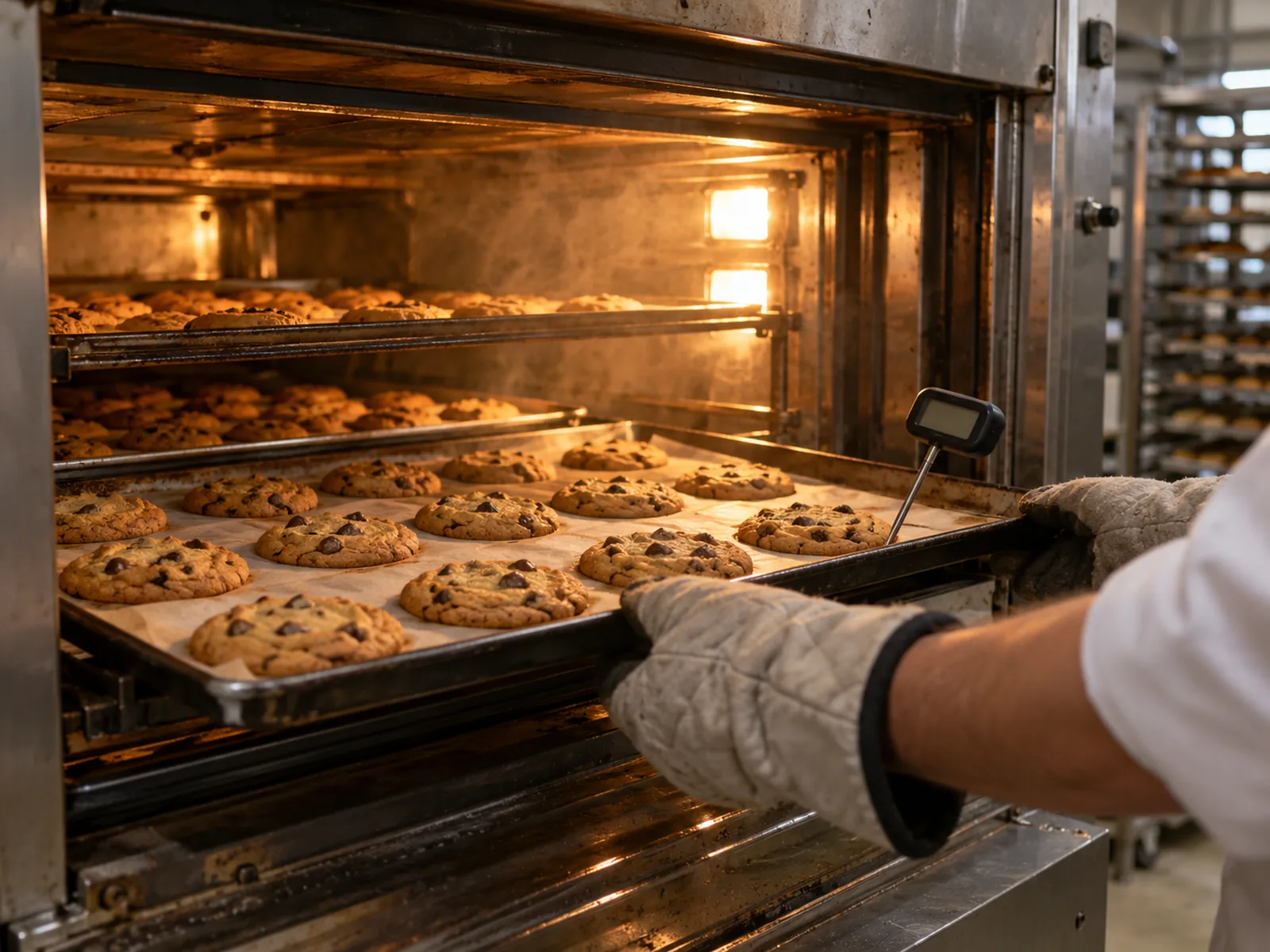
Introduction
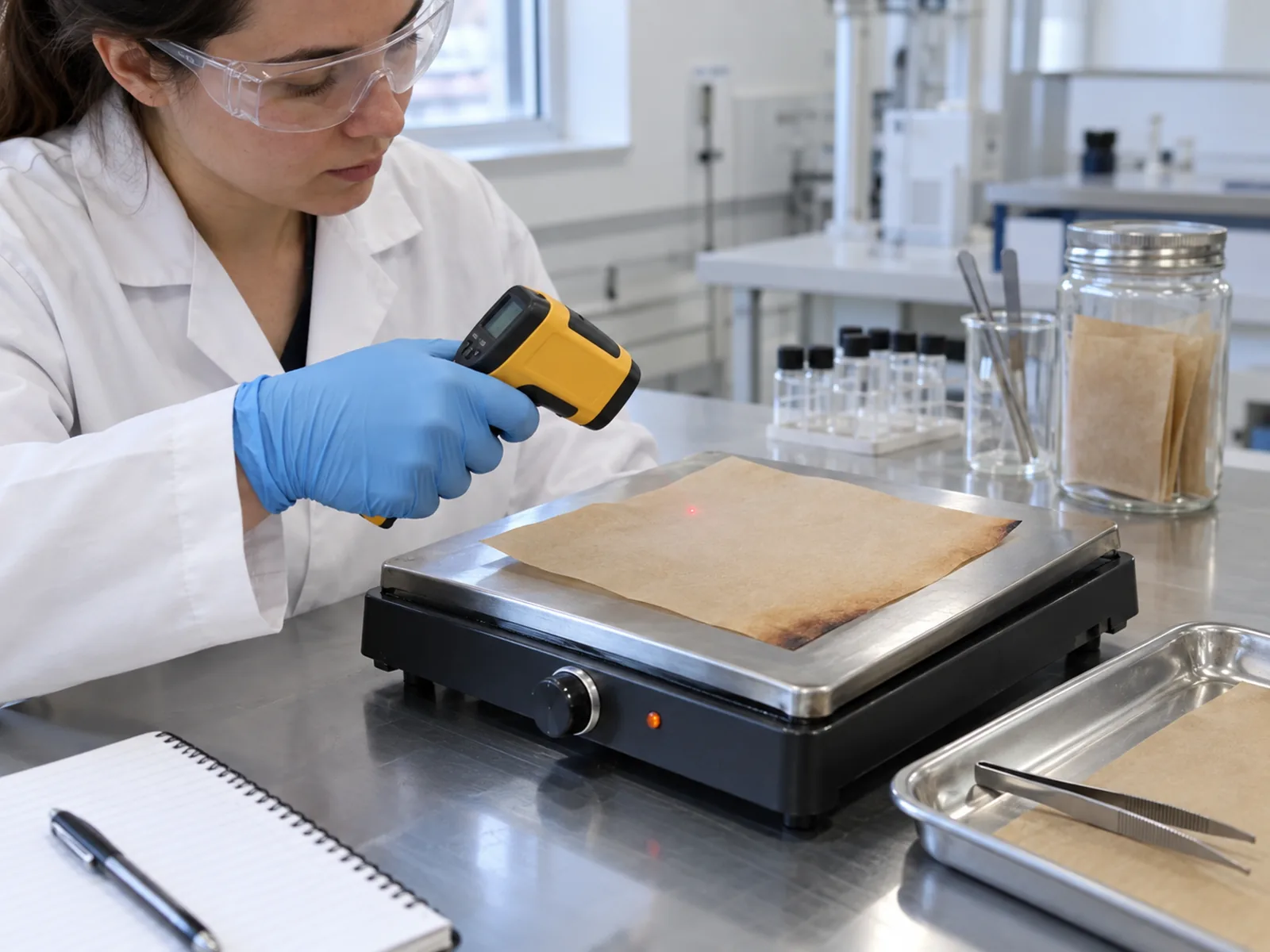
How hot can baking paper actually get? For most silicone-coated constructions the working answer is a continuous rating around 220°C, with short excursions higher — but the number only means something when it is tied to dwell time, oven atmosphere and contact conditions. Buyers who purchase on temperature alone end up with paper that browns, embrittles or leaves residue on product. Buyers comparing these specifications can review our baking parchment paper manufacturing programme programme, where coating weight, base grammage and release values are documented per construction.
Heat performance is not one property. It is the combined behaviour of the base sheet, the coating system, the cure state of that coating and the environment inside the oven. Steam injection, sugar-rich batters, radiant elements and long holds each move the effective limit. Buyers verifying these specifications can review the certificate library alongside supplier documentation requests.
This guide is for industrial bakeries, frozen and par-baked producers, distributors and private-label teams: where limits come from, how grammage and coating interact with heat, which applications need upgrades, and how to verify a claim.
1. Where Temperature Limits Actually Come From
A rating describes the whole construction under defined conditions, not the fibre alone. For production volumes, the same construction logic applies to our private-label parchment paper supplier line, quoted per roll, sheet or die-cut format.
Cellulose discolours and loses strength well above 200°C, and degradation depends on time as much as peak temperature. A sheet held at 200°C for forty minutes behaves very differently from one flashed at 240°C for six. The factory and certificate library lists the third-party audits and test reports behind these claims.
The silicone coating usually reaches its limit first. Silicone tolerates temperatures far above normal baking, but the practical ceiling is set at the surface: oxidation, loss of release and eventual embrittlement. Cure quality matters — under-cured coating releases poorly and can transfer, while over-cured coating becomes brittle and cracks.
Oven atmosphere is the variable most often missed. Dry convection heat is the mildest case. Steam-injected deck ovens combine heat with saturated moisture and accelerate degradation. Air fryers and impingement ovens create hot spots and can physically lift lightweight sheets.
Contato matters too: paper against wet batter runs cooler than the air because evaporation buffers it, while paper on a hot metal deck can run hotter.
2. Grammage, Coating and Heat Behaviour
Grammage — grams per square metre — sets thermal mass, rigidity and resistance to edge burn.
Lightweight sheets around 35 to 40 gsm heat quickly and suit short, moderate-temperature bakes where conformability and cost matter. They are prone to curling, scorching at exposed edges and lifting in high airflow.
Mid-range sheets around 40 to 45 gsm are the general-purpose choice for tray lining, standard muffin programs and most par-baked work.
Heavier sheets at 50 gsm and above resist edge burn, hold flat under airflow and suit long bakes, high-temperature bread and repeated-use liners, at the cost of higher sheet price and slower heat transfer.
Coat weight — silicone applied per side — governs release life more than heat limit directly. Heavier coats survive more cycles and higher sugar load, which is why high-heat work usually pairs a heavier coat with a heavier base rather than substituting one for the other.
Single versus double-sided coating is heat-relevant wherever both faces see heat and moisture: double-sided paper resists curl because both faces shrink at similar rates.
3. Matching Construction to High-Heat Aplicações
Specify by application rather than by a single number.
Artisan bread and high-temperature deck baking runs hot and long, often with steam. Specify a heavier base and robust coat weight, and confirm performance under wet rather than dry conditions.
Roasting and sheet-pan convection work runs moderate temperatures for longer dwell with fat and sugar present, so prioritise coat weight and base integrity over peak tolerance.
Air fryer and impingement applications need sheets that will not lift. Increase grammage or use a perforated or formed format that lets airflow hold the sheet down.
Grilling, broiling and any process with radiant elements should be treated as out of scope unless the supplier confirms a rating for that configuration; direct radiant exposure and open flame exceed any standard rating.
Repeated-use in-store liners need coating that survives multiple cycles, so validate release after the intended number of bakes, not just the first. Where product is baked in a cup, the temperature question shifts to the cup's base stock, so evaluate the formed cup separately from flat sheet.
4. Recognising Heat Failure on the Line
Most failures present predictably, and catching them early prevents a batch write-off.
Browning or scorching at exposed edges means the continuous rating is exceeded or the sheet is too light for the airflow. Deep uniform browning suggests the oven is running hotter than the setpoint.
Embrittlement — paper that cracks when flexed after baking — indicates fibre degradation or over-cured coating. Early in the bake, suspect the rating; after several cycles on a reusable liner, suspect coating life.
Loss of release is usually a coating issue accelerated by heat. Sugar and egg wash caramelise and weld at high temperature, so a construction that releases well at 180°C may fail at 220°C with the same recipe.
Smoke or odour is a hard stop: the sheet is degrading, and product from that batch should be assessed before release.
Curl and lift is mainly a grammage and single-sided coating problem, worsened by airflow.
5. Verifying a Temperature Claim Before You Buy
Ratings are easy to state and harder to prove, so build verification into supplier approval.
Ask for the number in writing with its conditions: maximum continuous temperature, dwell time at that temperature, dry air or steam, single use or multiple cycles. A supplier who cannot state conditions alongside the number has not tested it.
Request a declaration of compliance for the exact SKU covering food-contact status: the EU framework regulation supported by good manufacturing practice rules, or an applicable US food-contact authorisation.
Run a production-representative trial rather than a laboratory coupon: your product, your trays, your oven, your setpoint and dwell. Score release, residue, sheet appearance, colour development on the product base and odour — and repeat at the top of your temperature range, not the middle.
For large or aggressive programs, commission independent migration testing under the actual time and temperature conditions.
Insist on written change control covering base supplier, grammage, coat weight and curing parameters. Many heat failures blamed on ovens are in fact unannounced construction changes between lots.
6. Writing the Specification
Keep it short enough to enforce and complete enough to prevent substitution. State base paper type and grammage with tolerance, number of coated faces, coat weight per side, maximum continuous temperature and dwell, oven type and atmosphere including steam injection, contact conditions such as fat, sugar and moisture load, format and dimensions with tolerance, single or multi-cycle intent, and destination markets.
Add acceptance criteria — appearance after bake, release scoring method, residue tolerance and odour check — plus the documentation set, lot traceability and change-control terms. Include pack and pallet configuration, because a sheet curled from humid storage will not lie flat on a hot tray.
Where sites run several oven types, consider one construction covering the most demanding route rather than a SKU per site.
Conclusion
Baking paper temperature limits are a construction question, not a marketing number. Specify grammage for thermal mass and flatness, coat weight for release life at temperature, and double-sided coating wherever heat and moisture reach both faces. Match the construction to the oven atmosphere, since steam and high airflow move the effective limit more than most datasheets suggest. Then verify: get the rating in writing with conditions, trial your own product at the top of your range, and lock the construction with change control. Our pre-cut parchment paper sheets and rounds programme publishes the test data behind each grade so specifications can be verified before ordering.
What is the maximum oven temperature for baking paper?
Most silicone-coated baking paper is rated for continuous use around 220°C, with brief tolerance higher. Confirm whether that rating was established in dry air or with steam, and whether it covers single or repeated cycles.
Does higher grammage mean higher temperature resistance?
Not directly. Grammage adds thermal mass and reduces edge burn and curl, but the coating sets the practical ceiling — so high-heat work usually specifies heavier grammage and a heavier coat together.
Can baking paper be used in a steam-injected deck oven?
Yes, but specify for it. Steam accelerates degradation, so confirm the rating under wet conditions, choose a heavier base with adequate wet strength and validate with your own dough.
Why does my baking paper turn brown at the edges?
Usually the sheet is too light for the temperature and airflow, or the oven runs hotter than the setpoint. Increase grammage, reduce exposed overhang and check calibration.
Is single-sided or double-sided coating better for high-temperature baking?
Double-sided. With only one coated face the two faces shrink differently under heat and the sheet curls, lifting edges into hotter air. It also copes better where condensate is present.
How can buyers verify a supplier's temperature rating?
Request the rating in writing with dwell, atmosphere and cycle count, then trial your own product at the top of your range, scoring release, residue, appearance and odour. For large programs, commission independent migration testing.
CTA
Send LANGMAI your oven type, maximum setpoint and dwell, product and recipe characteristics, grammage and format requirements, volumes and destination market. The team can propose suitable silicone-coated constructions with stated heat ratings, arrange production-representative samples for oven trials and prepare a quote-ready specification.