Introduction
Most baking paper is bought on a single-bake impression: one tray, one good release, one clean sheet. Commercial bakeries do not use paper that way. In many operations the same sheet covers two, three or more tray cycles, and in others the paper must survive a second bake after cooling on the rack. When reuse is part of the real workflow, the number that matters is not the price per sheet but the release performance at bake three, bake four, and beyond. Buyers comparing these specifications can review our pre-cut parchment paper sheets and rounds programme, where coating weight, base grammage and release values are documented per construction.
This guide defines a practical multi-bake evaluation protocol for buyers: what to measure, how to run the cycles, which failure signs to record, and how to convert the results into a defensible cost-per-use comparison between suppliers. It is written for commercial bakeries, foodservice groups, and private-label brands comparing baking paper and parchment formats for volume production. Buyers verifying these specifications can review the certificate library alongside supplier documentation requests.
LANGMAI manufactures silicone-coated baking paper, greaseproof formats and related food-paper products for wholesale buyers, and supports sample-based evaluation before quotation. The protocol below is supplier-neutral; it works for any candidate material you are comparing.
Why Single-Bake Testing Misleads Commercial Buyers
A first bake is the easiest test a baking paper can pass. The silicone surface is at its freshest, the sheet is flat, and any food residue from previous cycles is absent. The problems that drive complaints and hidden costs appear with repetition: For production volumes, the same construction logic applies to our custom printed baking parchment paper line, quoted per roll, sheet or die-cut format.
- Release force rises as the coating wears or contaminates, so product tears or sticks on later cycles.
- Browning and brittleness accumulate at the edges, which matters for handling and for perception in open-tray service.
- Moisture and fat migration can change the sheet's behavior between bakes, especially in products with high-fat or high-sugar contact surfaces.
- Sheets shrink or distort, which affects alignment on trays and in automated lines.
A buyer who evaluates only the first bake will systematically overestimate the performance of a weaker sheet, because every candidate looks identical when it is new. The factory and certificate library lists the third-party audits and test reports behind these claims.
What Buyers Should Define Before Running the Protocol
Before any testing, write down the conditions that match your production reality. A protocol that does not reflect the bakery will produce results that do not transfer.
- Product and dough type: high-sugar, high-fat, and lean doughs interact differently with the release surface.
- Bake temperature and time: record the real setpoint and the measured tray-zone temperature, not just the recipe target.
- Number of cycles per sheet in normal use: two, three, or more, and whether reuse happens consecutively or after cooling.
- Tray type and airflow: perforated trays, solid trays, and convection versus static ovens change heat transfer at the sheet.
- Contato pressure and coverage: full-sheet coverage behaves differently from spaced portions at the edges.
The Multi-Bake Evaluation Protocol
Use the same batch of paper for all candidates and run at least three sheets per candidate so a single outlier does not decide the comparison.
Step 1: Baseline documentation
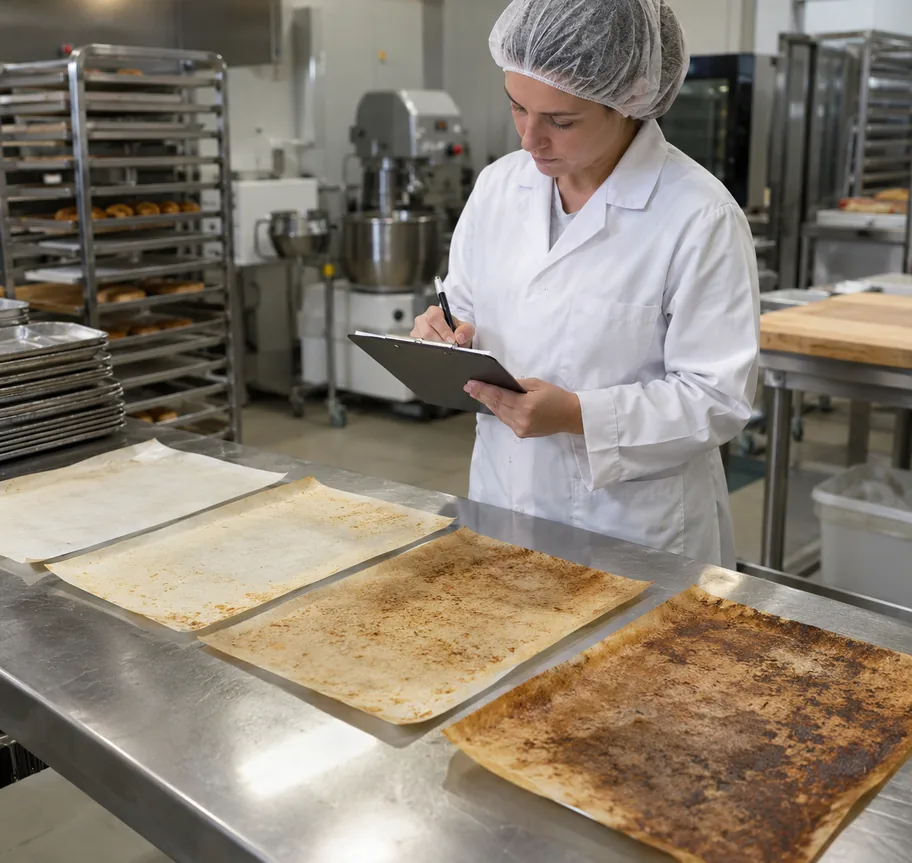
Record grammage, caliper, silicone application claims, and the supplier's stated maximum use temperature before the first bake. Photograph each fresh sheet under consistent lighting. These references make later changes visible and discussable.
Step 2: Bake cycles under production conditions
Bake the representative product on the candidate sheet at your real setpoint. After each cycle, return the sheet to the tray in the same orientation and repeat for the target number of cycles. If your operation reuses paper after cooling, include a cooling interval in the protocol, because thermal cycling is part of the real stress.
Step 3: Score release after every cycle
After each bake, record a simple release score:
- 5: product lifts cleanly with no sticking or residue
- 4: minor release effort, no damage
- 3: product releases with tearing or surface residue
- 2: significant sticking, product damaged
- 1: product must be removed from the paper
The score at the final cycle matters most, but the trend between cycles one and three is what reveals coating quality. A sheet that starts at 5 and drops to 2 by bake three will cost more than a sheet that holds at 4.
Step 4: Record physical condition
After the final cycle, evaluate the sheet itself: edge browning, brittleness or cracking when flexed, shrinkage against the original dimensions, and any odor. Note whether the sheet would still be acceptable for the next cycle in your operation, because your reuse policy determines whether the material has reached the end of its useful life.
Food-Contato Stability Across Reuse
Reuse raises a compliance question that single-use purchasing can ignore: does the release surface remain within its food-contact limits through the intended number of cycles? Buyers should ask each supplier for the conditions their food-contact declaration covers, including maximum temperature and whether repeated use is supported or the declaration assumes single use. Where a supplier supports multi-bake use, the migration test report should reflect the conditions of repeated contact rather than a single exposure.
This point matters for private-label brands in particular, because the brand carries the finished-product compliance file in the US and EU. A sheet that is marketed for multiple uses should be able to show documentation consistent with that claim. LANGMAI's food-contact and migration documentation is provided per product and market so buyers can align the paper file with their own label claims.
Converting Results into Cost per Use
The economics of reuse are straightforward once release scores exist. Cost per use is the sheet price divided by the number of cycles it completes while still meeting your release and appearance standards. A sheet that costs twice as much but holds release for four cycles instead of one is cheaper per bake and cheaper to handle, because fewer sheet changes interrupt the line.
Include three additional factors in the comparison:
- Change frequency: every sheet replacement is handling time on the line, and in automated lines it may be a stoppage.
- Rework and waste: failed releases produce damaged product that shows up in yield, not in the paper invoice.
- Disposal volume: fewer sheets per shift means less waste handling, which matters for operations with waste-cost targets.
A supplier who can document durable release performance across cycles is offering a different product from one who competes only on first-bake appearance.
How to Evaluate Suppliers on Reuse Performance
Use the protocol output as a structured supplier conversation:
- Ask whether the silicone system is designed for multi-cycle use, and what evidence supports that.
- Ask for the maximum continuous use temperature and how it relates to your measured tray-zone temperature.
- Ask for migration and food-contact documents that match your reuse policy.
- Ask for grammage and coating consistency controls across the roll width, because release decay often starts where the coating is thinnest.
LANGMAI supports sample-based evaluation with buyer-side protocols like this one, and can quote against the cycle count, format, and certification requirements the buyer defines.
Inspection and Release Checklist for Reuse Programs
For bakeries that formalize paper reuse, add these points to the incoming and in-process checks:
- Sheet dimension and flatness at receiving, against the specification.
- Grammage verification on each lot.
- Release scoring during the first production run of each new lot, using the same scale as the evaluation protocol.
- Sheet retirement criteria: define the score or physical condition at which a sheet is removed from service.
- Retained samples from each lot, linked to the batch records.
FAQ
How many times can baking paper be reused in a commercial bakery?
It depends on the coating system, the product, and the bake temperature. High-quality silicone-coated sheets commonly support several cycles for low-sugar products at moderate temperatures, while high-sugar or high-fat contact can reduce usable cycles sharply. The evaluation protocol above exists precisely because the honest answer is product-specific.
Does reusing baking paper affect food safety?
Reuse is acceptable when the sheet remains intact and within its food-contact declaration conditions. The review points are physical degradation, retained residues between cycles, and whether the supplier's migration documentation supports repeated contact at your bake temperature.
Is heavier grammage always better for multiple bakes?
Heavier grammage generally improves durability and handling, but release performance across cycles depends more on the silicone system than on weight alone. Evaluate release decay directly rather than inferring it from grammage.
Can LANGMAI support this evaluation with samples?
Yes. LANGMAI provides baking paper samples for buyer-side protocols, and the sales team can align grammage, width, coating type, and certification requirements with the cycle count your operation intends to run. Contato Sales with your product, tray, and temperature details to receive matched samples and a quotation.
Conclusion
Multi-bake release testing converts baking paper from a consumable you buy by impression into a material you buy by measured performance. Run the protocol under your real conditions, score release after every cycle, verify that food-contact documentation matches your reuse policy, and compare suppliers on cost per use rather than price per sheet. The result is fewer failed releases, less rework, and a paper specification you can defend to any customer audit. Our silicone-coated parchment sheets and rolls programme publishes the test data behind each grade so specifications can be verified before ordering.
CTA
Contato Sales for LANGMAI baking paper samples matched to your product and bake conditions, together with specifications, food-contact documents, and wholesale quotation.