Introduction
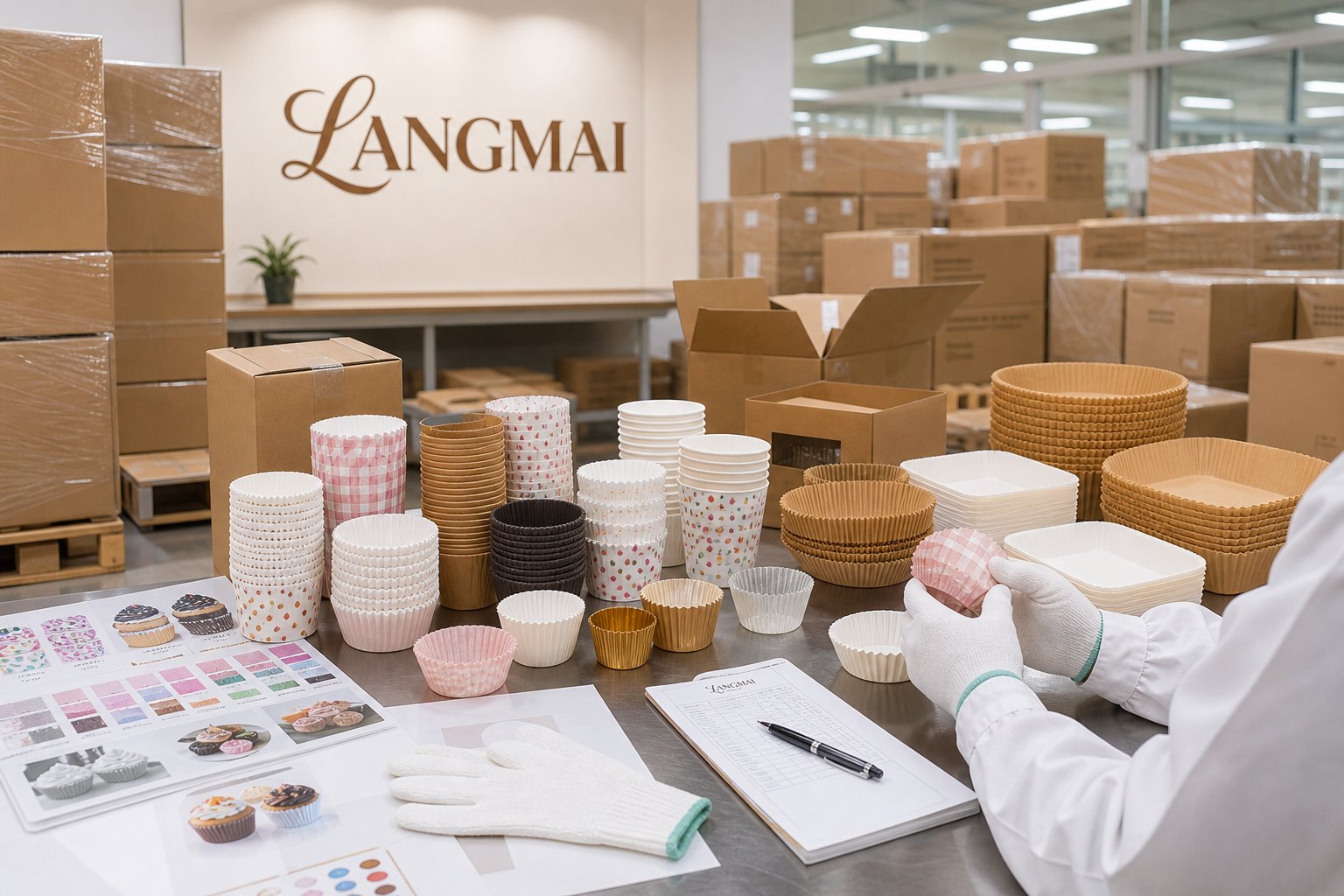
Custom printed food paper packaging looks simple from the outside: a printed cupcake liner, a muffin cup with a brand logo, or a printed baking cup carrying a seasonal design. Behind the print, however, there is a chain of decisions about ink chemistry, substrate interaction, color management, and food-contact compliance that determine whether a printed article is acceptable for bakery, foodservice, or retail use.
For buyers sourcing from a printed baking cups manufacturer, the most common pain points are predictable: an unexpected ink smell in the sealed carton, colors shifting between the approved proof and the production run, missing migration statements, or documentation that does not match the destination market. These issues are rarely caused by a single mistake; they usually reflect a supplier who has not been asked the right questions early in the evaluation.
This article gives procurement teams, bakery brand managers, and private-label buyers a structured evaluation framework. It covers odor assessment, ink–coating–substrate interaction, rub and set-off checks, color approval under controlled lighting, the scope of food-contact documentation, sample approval flows, production controls, shipment inspection, retail packaging, and how to send a quote-ready RFQ. It also explains how a China-based manufacturer such as LANGMAI approaches low-odor ink options, while making clear that compliance must always be assessed for the specific finished article, intended food, time/temperature conditions, and destination market.
1. Why Printed Paper Packaging Demands a Different Buyer Checklist
Printed paper packaging for food is not generic print. The same ink that works on a shopping bag may not be appropriate for a baking cup that sits on a warm muffin, or a wrapper that contacts chocolate. Buyers evaluating a supplier should therefore separate two questions: *Can they print well?* and *Can they print food-contact-safely?*
A useful first step is to ask the supplier how they organize these two disciplines. Buyers should ask how artwork management, ink selection and substrate specifications are controlled together. Useful evidence includes ink references tied to substrate grades, color targets tied to production conditions and documentation tied to the finished article under review.
2. Low-Odor Ink: What “Low Odor” Actually Means
There is no single global standard that defines “low odor” printing ink for food paper packaging. The term is a commercial descriptor, not a regulatory class. For buyers, this means the label alone is not enough; the question is how odor is controlled and verified.
Under the European framework, food contact materials (FCMs) must not unacceptably change the taste or odor of food, as required by Regulation (EC) No 1935/2004. In practice, buyers should establish with the supplier how the finished printed article's sensory impact will be evaluated for the intended food and use conditions.
LANGMAI offers specially formulated low-odor ink options selected to help reduce noticeable odor in the finished cup. Performance still depends on the substrate, coating, print coverage, production conditions and the time between production and use. Buyers should therefore treat “low odor” as a controlled property, not a universal guarantee.
2.1 How to evaluate odor in incoming samples
A practical buyer-side method is an odor evaluation after sealed storage. Place printed and unprinted control samples in separate clean, odor-neutral containers for an agreed period, then compare them under the same conditions. If accelerated or heated sensory testing is relevant, agree the method with the supplier or a qualified laboratory instead of improvising a temperature. Record the method and observations consistently across suppliers.
3. Ink, Coating and Substrate: Why They Must Be Evaluated Together
Ink does not sit in isolation. It sits on a coating, which sits on a base paper, which may carry its own additives for grease resistance or release. Each layer can influence odor, color, and migration. A buyer who evaluates only the ink is missing most of the picture.
LANGMAI matches ink systems to its base paper and coating grades rather than offering a single universal ink. For buyers, the practical implication is that color, odor, and compliance should be re-verified whenever the substrate, coating weight, or ink coverage changes. A proof printed on one paper grade is not a valid reference for production on another.
4. Color Approval: From Screen to Press Under Controlled Lighting
Color is one of the most frequent sources of dispute in custom printed food paper packaging. The same artwork can look different on a calibrated monitor, under office LED, under retail track lighting, and inside a bakery display case. A disciplined color approval flow reduces this risk.
4.1 Reference conditions and targets
Buyers should agree reference lighting, observation conditions and substrate background with the supplier before proofing. A physical color target is more reliable than screen values alone. If an instrumental color tolerance is required, define the method and acceptance range in the approved specification and ask what production records can be supplied.
4.2 Approved master sample
Once a proof is signed off, it becomes the approved master sample. All later production is referenced back to this sample. Any change in substrate, ink batch, or press condition that could shift color should trigger a new master sample rather than a silent drift.
5. Rub and Set-Off: Simple Tests With Outsized Impact
Two physical checks deserve a place in every buyer’s sample routine:
- Rub resistance. Lightly rub the printed surface with a white cotton cloth or tissue under consistent pressure. Any visible transfer indicates the ink is not adequately set for the intended use.
- Set-off (blocking). Stack printed articles under a light weight in conditions similar to the packed product (for example, warm and humid for bakery cups). Inspect the facing surfaces for ink transfer.
These tests do not replace laboratory migration testing, but they flag obvious problems before samples are circulated to brand or quality teams.
6. Food-Contacto Documentation: Scope Matters More Than Paper Quantity
A common buyer mistake is to assume that any document mentioning “food contact” or “FDA” is sufficient. In practice, the value of a document is determined by its scope: which materials and inks are covered, which food types are covered, which temperatures and times are covered, and which regulatory framework it references.
6.1 European framework: 1935/2004 and 2023/2006
In the EU, FCMs are governed by Regulation (EC) No 1935/2004, which sets the general requirement that materials must not transfer constituents to food in quantities that endanger health, change food composition, or deteriorate organoleptic properties. Regulation (EC) No 2023/2006 requires that FCMs be manufactured in accordance with Good Manufacturing Practice (GMP), with documented quality assurance and quality control systems.
For a printed baking cup, buyers commonly request a supplier declaration and supporting evidence for the base paper, coating and ink system, together with information showing that production is controlled under GMP. The exact document set depends on the material and market, so buyers should ask which layers and use conditions are covered rather than only whether a document exists.
6.2 United States framework: 21 CFR Parts 174–179
In the US, FDA 21 CFR Parts 174–179 regulate indirect food additives, including coatings and components of paper and paperboard. Buyers selling into the US market should ask suppliers whether the ink and coating components are suitable for use under these regulations for the intended food and temperature conditions. This article does not constitute legal advice; compliance must be assessed for each finished article and use condition.
6.3 Destination-market reality
Most buyers do not sell into a single market. A printed cupcake liner shipped to the EU, the US, and the Middle East may need to satisfy different positive lists, different migration limits, and different labeling expectations. The supplier’s documentation should identify the destination markets it is intended to support, and the buyer should confirm that scope before issuing a purchase order.
7. From Sample to Production: A Repeatable Approval Flow
A clear sample flow protects both sides. A practical structure is:
- Pre-sample brief. Substrate, dimensions, ink system, color references, intended food, time/temperature, and destination market are agreed in writing.
- Digital proof. A PDF proof is reviewed for layout and text. Color is acknowledged but not finalized at this stage.
- Physical sample. Printed on the production substrate, with a production color check against the agreed reference.
- Approved master sample. Signed by both sides, stored as the reference for production.
- First-piece check. At the start of production, the first pieces off the press are checked against the master sample before the run continues.
- In-process and shipment inspection. Ongoing checks during the run and a final inspection before cartons are sealed.
Buyers should implement this type of documented approval flow for each project. The important principle is that each step leaves a reference and a record.
8. Production Controls Buyers Can Ask Sobre nosotros
Buyers do not need to become press operators, but they should know which controls a serious supplier has in place. Useful questions include:
- How are ink batches traceable to specific production runs?
- How is the press cleaned between jobs, and is there a documented changeover procedure that prevents ink cross-contamination?
- How is the production color check performed, and how often?
- How is the first-piece check documented?
- How are finished goods stored between production and shipment to control odor and moisture?
These questions reveal whether a supplier treats food-contact printing as a controlled process or as general commercial printing.
9. Shipment Inspection and Retail Packaging
The final opportunity to catch problems is before the goods leave the factory. A shipment inspection typically covers:
- Carton marks. Correct buyer name, article reference, quantity, batch or lot number, and destination.
- Inner packing. Correct count per sleeve or bag, clean poly liners where used, and absence of foreign odor in the sealed carton.
- Random pull. A small sample is pulled from finished cartons and checked against the approved master sample for color, print position, and physical integrity.
- Pallet and load. Pallet condition, wrap, and load stability for the planned transport.
Retail-ready packaging requirements (barcode placement, bundle counts, shelf-ready trays, language on-pack) should be agreed in the RFQ so they are part of the original quote rather than a late change.
10. Sending a Quote-Ready RFQ
A clear RFQ shortens the quotation cycle and reduces misunderstandings. Useful fields include:
- Product type (for example custom printed cupcake liners or custom printed muffin baking cups)
- Substrate and grammage preference
- Dimensions and shape
- Print coverage and number of colors
- Color references (Pantone, physical sample, or both)
- Intended food and use conditions (time, temperature)
- Destination market(s) for compliance
- Required documentation (DoC, GMP evidence, US FDA statements)
- Inner pack and carton specification
- Target quantity per SKU
- Inspection expectations
Submitting these details through the LANGMAI customization request and inquiry form gives the factory a complete brief from the first contact. Buyers who want to review quality systems and certificates in advance can also request access to the factory certificates page.
> Mid-article CTA: Ready to evaluate LANGMAI’s low-odor ink options against your reference sample? Send your artwork and target specification through the customization page to support a quotation and customization discussion.
Buyer Evaluation Checklist
| Checkpoint | What to ask or do | Why it matters |
|---|---|---|
| Low-odor ink | Request ink description and odor evaluation method | Confirms odor is controlled, not just claimed |
| Ink–coating–substrate fit | Confirm ink matched to specific paper grade | Avoids surprises when substrate changes |
| Color approval | Use D65/D50 reference lighting and physical target | Reduces color drift between proof and production |
| Approved master sample | Sign and store a physical reference | Anchors all later production checks |
| Rub and set-off | Run simple physical tests on samples | Flags under-cured ink before lab testing |
| EU documentation | Ask for 1935/2004 DoC and 2023/2006 GMP evidence | Confirms EU market suitability and GMP |
| US documentation | Ask for 21 CFR 174–179 suitability statement | Supports US market suitability |
| Destination scope | Confirm which markets the documents cover | Prevents mismatched compliance claims |
| First-piece check | Ask how it is documented | Detects drift before a full run |
| Shipment inspection | Agree carton marks, inner pack, and pull rate | Protects against late surprises |
FAQ
What is “low-odor ink” in food paper packaging?
Low-odor ink is a commercial descriptor for ink systems formulated to minimize residual smell in the finished printed article. It is not a regulated term. Buyers should evaluate it through a documented odor assessment rather than relying on the label alone.
Does LANGMAI’s low-odor ink guarantee no odor at all?
Low-odor ink is an ink option selected to reduce noticeable odor in the finished printed article; it does not mean odor-free. LANGMAI offers specially formulated options, but actual performance depends on the substrate, coating, print coverage, production conditions and storage. Any odor claim should be verified on the finished article under the intended use conditions.
Which EU regulations apply to printed baking cups?
Printed baking cups sold in the EU are generally subject to Regulation (EC) No 1935/2004 for general safety and organoleptic neutrality, and to Regulation (EC) No 2023/2006 for Good Manufacturing Practice. Specific measures may also apply to certain materials.
Are FDA 21 CFR Parts 174–179 enough on their own?
No. These parts provide a framework for components of food-contact articles in the US, but suitability must be assessed for the specific finished article, the intended food, and the conditions of use. They should not be treated as a blanket approval.
How should buyers test color before approving a production run?
Buyers should evaluate proofs under agreed reference lighting (typically D65 or D50) against a physical color target, not a screen. The signed physical proof should become the approved master sample used for all later production checks.
What information should a quote-ready RFQ include?
A quote-ready RFQ should include product type, substrate, dimensions, print colors and coverage, color references, intended food and use conditions, destination markets, required documentation, packaging specification, target quantity, and inspection expectations.
CTA
If you are comparing printed baking cups manufacturers for a new launch or a private-label program, submit artwork and specifications through the LANGMAI customization page or send your brief directly via the inquiry form. For buyers who want to review quality documentation first, the factory certificates page is the right starting point.
Conclusion
Evaluating custom printed food paper packaging is ultimately about asking better questions earlier. Low-odor ink is a useful starting point, but it only delivers value when it is matched to a defined substrate, coating, and use condition. Color accuracy depends on agreed lighting, a physical reference, and a documented first-piece check. Food-contact documentation is meaningful only when its scope matches the finished article, the intended food, the time/temperature conditions, and the destination market.
A disciplined approval flow, a quote-ready RFQ, and a supplier that treats printing and food-contact production as one integrated process are the three factors that most often separate smooth launches from costly rework. Buyers who build their evaluation around these elements, rather than around headline claims, are best positioned to select a printed baking cups manufacturer they can scale with.
Sources
- European Commission – Food Contacto Materials: https://food.ec.europa.eu/food-safety/chemical-safety/food-contact-materials_en
- European Commission – FCM Legislation (including Regulations (EC) No 1935/2004 and 2023/2006): https://food.ec.europa.eu/food-safety/chemical-safety/food-contact-materials/legislation_en
- U.S. FDA – Determining the Regulatory Status of Components of a Food Contacto Material (21 CFR Parts 174–179): https://www.fda.gov/food/packaging-food-contact-substances-fcs/determining-regulatory-status-components-food-contact-material