Introduction
Buyers rarely choose to change a grease-resistant paper specification. They are moved to it, usually by a customer questionnaire, a retailer audit or a sales-market rule with a hard date attached. For food paper packaging the driver is almost always greasy-food performance: the property that made fluorochemical treatments attractive for decades is now the property that puts a product inside the scope of PFAS restrictions. Every document in our compliance library is tied to a specific construction; see how the custom silicone-coated baking parchment paper programme aligns test reports with the exact grade supplied.
The transition is manageable if it is treated as an engineering and documentation programme rather than a substitution. A buyer has to decide which SKUs are in scope, what grease load each must survive, which fluorochemical-free technology meets that load at acceptable cost, and what evidence the destination market expects. Skip any of those steps and the familiar failure follows: a cheaper alternative that passes on paper and fails under hot, fatty contact. Buyers verifying these specifications can review the certificate library alongside supplier documentation requests.
This guide sets out why the rules are changing, what the US and EU positions look like in practice, how the main alternatives differ, and the document package to request before approving a new construction.
1. Why Greasy-Food Rules Drive the Change
PFAS chemistry delivers oil and water resistance at very low treatment levels, which is why it became standard on microwave popcorn bags, fast-food wraps, pizza liners, bakery cups and moulded fibre trays. The regulatory response targets exactly that use: fibre-based packaging that contacts fatty or oily food. Documentation scope is confirmed per SKU and destination market, as outlined on our wholesale parchment paper rolls and sheets page.
The practical consequence is scope confusion. Restrictions are generally written around PFAS that is intentionally added and around total fluorine as a screening proxy, not around a named product category. A plain uncoated kraft item can fall outside concern while a grease-resistant variant sits squarely in scope. Segment the range by declared function: anything sold on a grease-resistance or non-stick claim needs evidence, and anything without such a claim should still be checked for upstream contamination. Where a PFAS-free declaration is required, our PFAS-free baking paper programme documents the transition grade by grade.
2. The US Position: State Laws Ahead of Federal Action
The federal and state positions are not the same thing. The FDA announced in February 2024 that grease-proofing substances containing certain PFAS were no longer being sold for food-contact use in the US market, and in January 2025 it determined that the related food-contact notifications were no longer effective. That closed new supply, but it is not a ban on stock already in warehouses or on imported inventory moving through distributors.
State law is where enforcement happens. A growing group of states, including California, New York, Washington, Minnesota, Maine, Colorado, Connecticut, Maryland, Vermont, Rhode Island, Oregon and Hawaii, has restricted intentionally added PFAS in food packaging or foodservice ware, with effective dates landing through 2026. Several use total fluorine at or below 100 parts per million as the practical screening line.
For national distribution, the only workable policy is to comply with the strictest applicable standard across the whole range. Managing a dozen state positions inside one SKU file costs more than qualifying one PFAS-free construction everywhere.
3. The EU Context
In the EU, Regulation (EC) No 1935/2004 sets the general framework for materials intended to contact food, and Regulation (EC) No 2023/2006 covers good manufacturing practice. On top of that, the packaging and packaging waste framework has introduced PFAS limits for food-contact packaging, and European Commission guidance issued in 2026 explains that packaging placed on the EU market after 12 August 2026 must meet the applicable limits, subject to scope and other Union rules.
The obligation attaches to the finished packaging and its placing-on-the-market event, not to a supplier's marketing statement. Ask the supplier to identify the exact product scope and the evidence used, and keep that answer with the approval record rather than in an email thread.
4. Fluorochemical-Free Alternatives and How They Differ
Three routes dominate the market, and they are not interchangeable.
- Mechanically treated greaseproof paper. Dense refining produces a paper whose pore structure resists oil penetration without added fluorochemistry. It performs well at moderate grease loads and short contact times, is the simplest to document, and is usually the closest cost match to conventional stock. Its ceiling is lower under hot, long-duration fat contact.
- Chemically treated, fluorochemical-free barrier systems. These include silicone-based treatments and bio-based or mineral coatings. They reach higher grease resistance, handle hot fatty food better, and are the usual choice for baking cups. Cost and compostability claims vary, so confirm both.
- Polymer dispersion or bio-polymer barrier layers. Applied as a thin film, these give the highest barrier but change the end-of-life profile and carry the highest cost premium. They suit specific applications rather than general bakery use.
Ask the supplier which route is used, at what application level, and what the validated grease load and temperature window are. "PFAS-free" describes what was removed, not what the item will survive.
5. Matching the Alternative to the Real Grease Load
Selection should start from the food, not the mill. Record food type, fat content, contact temperature, contact duration and whether the item is baked, served or transported. A muffin baked at high temperature in a cup is a different problem from a cold sandwich wrap, and a fried-food liner held for forty minutes is different again.
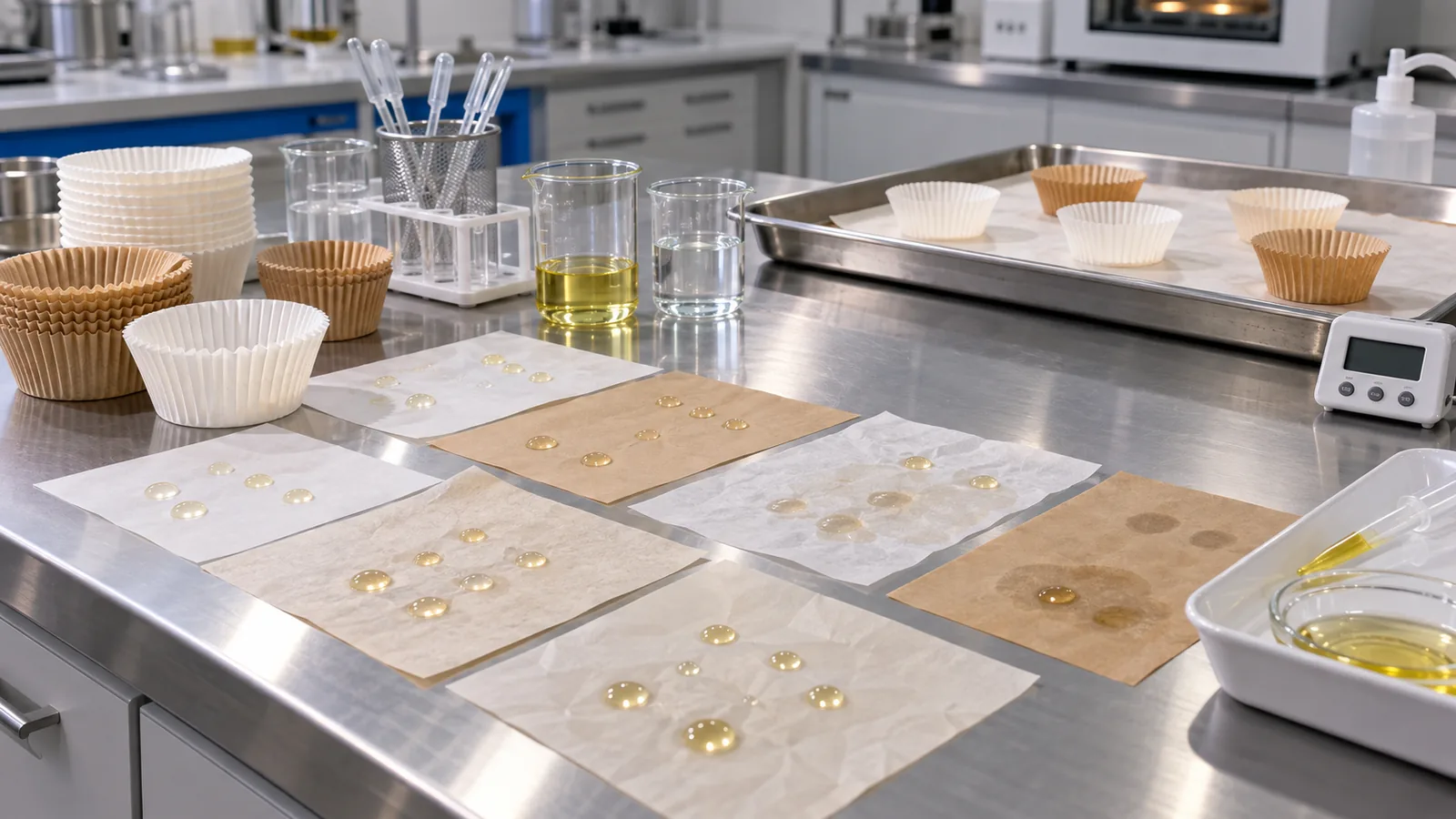
Then run an application trial rather than a desk comparison. Bake or serve the real product in the candidate construction, inspect for strike-through, wet-out, delamination, odour and release, and repeat with production-representative material. Where a range spans multiple products, qualify against the worst case and use one construction across the range so the document file stays simple.
6. Documents and Test Reports to Request
Build the file per SKU, not per supplier. This set is reasonable to request before first approval:
- A product-specific declaration of compliance naming the SKU, construction and fluorochemical-free statement, with revision date.
- A total fluorine or total organic fluorine test report from a recognised third-party laboratory, tied to the exact product code, with method, detection limit and date.
- Where a claim is made, the grease-resistance or oil-resistance method and result, with the food simulant or conditions used.
- A food-contact declaration referencing the applicable legal basis, food types and time and temperature limitations.
- Change-notification terms covering coating chemistry, base paper mill and recycled fibre content.
- Lot traceability coding and a retained-sample policy.
Treat the test report as the load-bearing document. A declaration without an analytical report tied to the same code is a statement of intent, and mills change feedstock, so agree to re-test annually or after any formulation change.
Conclusion
A PFAS-free transition works when it is scoped, tested and documented in that order. Segment the range by grease-resistance function, assume the strictest applicable standard covers the whole file, choose the technology against the real fat load and contact conditions rather than a catalogue description, and qualify it with an application trial on production-representative material. Then hold a per-SKU file with a dated third-party fluorine report, a product-specific declaration, method and scope, and change-notification terms. Buyers who do this convert a regulatory deadline into a one-off project; those who substitute on price alone repeat it. Our baking parchment paper manufacturing programme programme is audited against the same standards referenced in this guide.
Does "PFAS-free" mean the same thing as compliant with state law?
Not automatically. Most state restrictions are written around PFAS that is intentionally added, with total fluorine at or below 100 parts per million as the practical screening line, and some jurisdictions apply stricter approaches. Ask for a dated third-party fluorine report tied to the exact product code and check it against the rule in the destination market.
Is the FDA phase-out enough on its own?
No. The federal action stopped new sales of certain PFAS grease-proofing substances for US food-contact use, but it did not remove existing warehouse stock or imported inventory. State laws are where enforcement happens, so qualify to the strictest state standard you distribute into.
Which alternative performs best for high-fat bakery items?
For baked applications with high fat and long contact at temperature, chemically treated fluorochemical-free barrier systems — silicone-based or bio-based and mineral coatings — usually outperform mechanical greaseproof paper, which suits moderate grease loads and short contact. Confirm with an application trial on the real product.
How often should fluorine testing be repeated?
Agree an annual re-test as a baseline, and require immediate re-testing after any change to coating chemistry, base paper mill or recycled fibre content. Mills change feedstock, and a report from an earlier year does not describe the lot being purchased today.
Can recycled fibre reintroduce PFAS into a PFAS-free item?
It can. Contamination can enter through recycled content or mill processing aids even where no fluorochemistry was deliberately applied. Ask the supplier to state the recycled fibre content and whether incoming fibre is screened, and keep that answer with the approval record.
CTA
Send LANGMAI the product formats, food types, fat and temperature conditions, destination markets and current specification. The team can propose fluorochemical-free constructions, prepare samples for application trials and assemble the supporting declaration and test documentation.
Sources
- U.S. FDA market phase-out of grease-proofing substances containing PFAS
- U.S. FDA Food اتصل بنا Substances
- EUR-Lex Regulation (EC) No 1935/2004 on food contact materials
- EUR-Lex Regulation (EC) No 2023/2006 on good manufacturing practice
- European Commission guidance on Regulation (EU) 2025/40
- ECHA — Per- and polyfluoroalkyl substances (PFAS)
- BfR Recommendations on Food اتصل بنا Materials