
Introduction
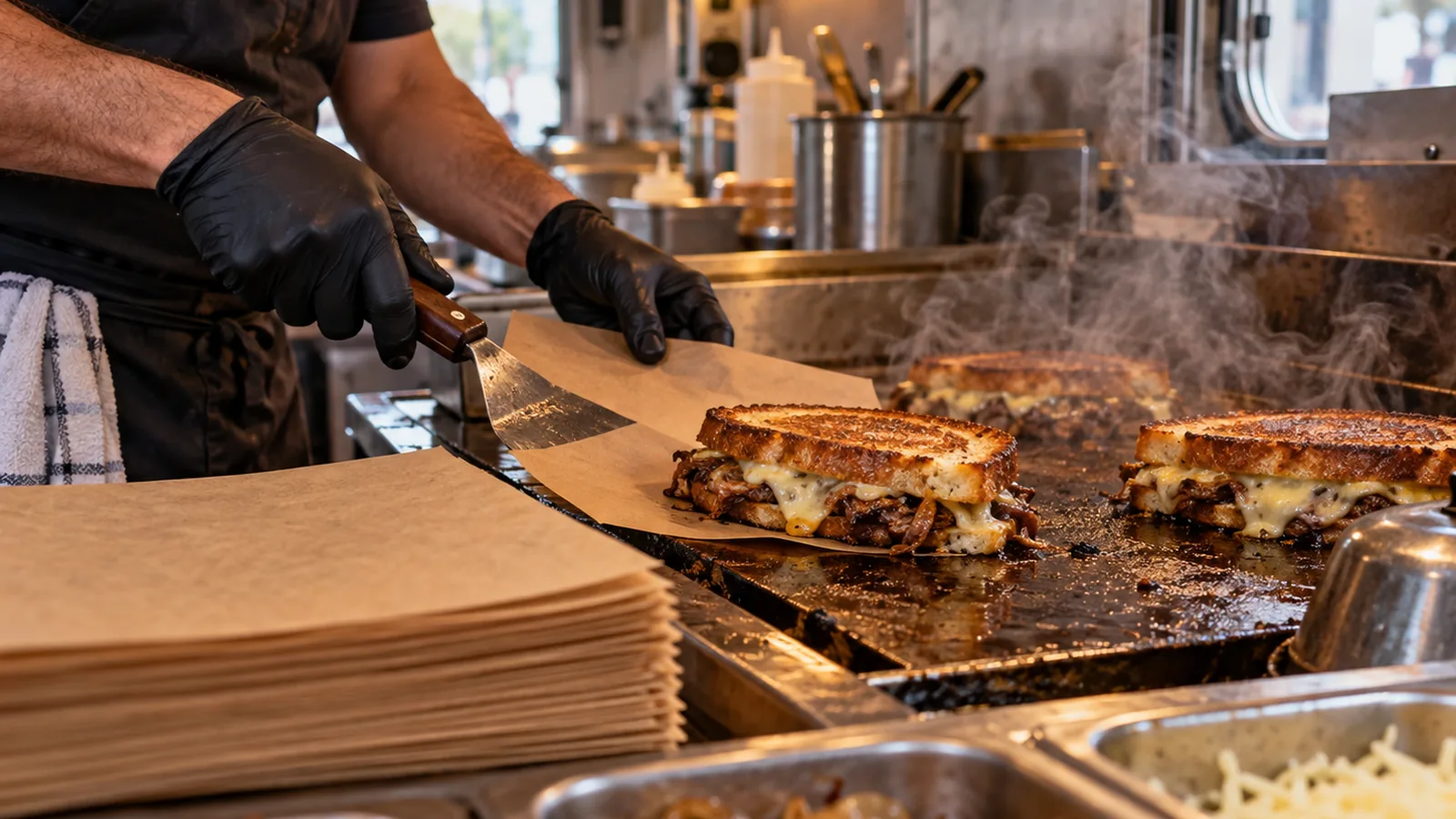
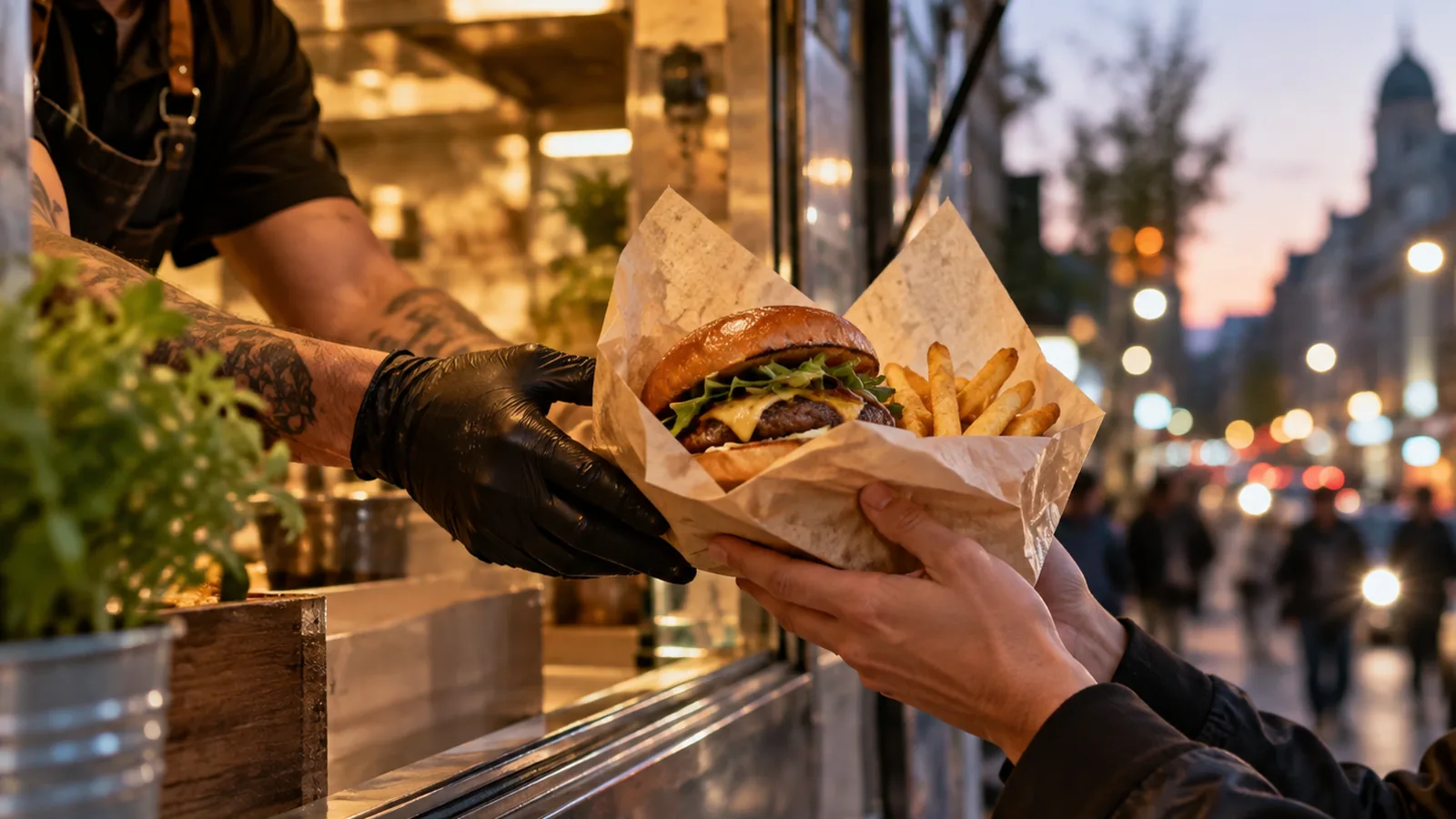
A food truck kitchen is not a scaled-down restaurant. One person works a window about a metre wide, everything must be reachable with one hand, storage is measured in cupboards rather than rooms, and a queue forms the moment service slows. Paper that works perfectly in a prep kitchen can fail badly in that environment. Buyers comparing these specifications can review our private-label parchment paper supplier programme, where coating weight, base grammage and release values are documented per construction.
For distributors and buying groups serving these operators, that difference is the whole business case. Mobile and concession accounts order less per drop but more often, they run out rather than over-stock, and they judge their supplier by whether the paper behaved during a busy service rather than by unit price. Buyers verifying these specifications can review the certificate library alongside supplier documentation requests.
This guide covers what mobile service demands of greaseproof paper, how to choose a grease-resistance level, when to sell rolls versus pre-cut sheets, how to size around truck ergonomics, how to plan quantities when storage is the constraint, and what documentation operators need.
1. What Mobile Service Demands From Paper
Four conditions define mobile use. اتصل بنا time with hot, oily food is short but intense, because fried chicken, burgers, loaded fries and doughnuts go straight into a wrap at high temperature. Moisture is constant, from sauces, steam and condensation inside a closed wrap. Handling is one-handed, with the operator usually holding something else. And there is no time or surface for cutting. For production volumes, the same construction logic applies to our pre-cut parchment paper sheets and rounds line, quoted per roll, sheet or die-cut format.
That combination rules out a lot. Uncoated deli tissue soaks through quickly. Paper without wet strength loses integrity the moment it meets sauce. Sheets that nest tightly are hard to separate with greasy hands. Anything stored loose blows around in a moving vehicle. Greaseproof paper — dense, calendared, oil-resistant without a plastic laminate — is the natural fit because it resists oil through the paper structure rather than through a coating that can crack or melt. The factory and certificate library lists the third-party audits and test reports behind these claims.
2. Choosing a Grease Resistance Level
Grease resistance is a specification, not a marketing word. Suppliers test it by methods such as kit rating or turpentine holdout, which lets you compare grades objectively. Instead of asking for "good grease resistance", ask for the method and result, then match it to the menu:
- Light holdout suits dry or low-fat items: pastries, cookies, cold doughnuts, bakery counter wraps.
- Medium holdout suits burgers, sandwiches, fries and most grilled items with short contact time.
- High holdout suits fried chicken, battered fish, anything rested in the wrap, or tray lining.
Buying one high level for everything is safe but expensive; buying too low brings strike-through complaints. Two grades cover most fleets.
Ask two more questions. First, wet strength: does the paper survive sauced or steamed food? Second, how resistance is achieved. Several jurisdictions restrict fluorochemical treatments in food contact paper, so request a statement that the grade is free of intentionally added PFAS, alongside standard food-contact documentation.
3. Roll, Sheet or Pre-Cut
Format determines labour, waste and unit economics.
- Rolls on a cutter box give the lowest cost per metre and stay tidy in a moving vehicle, but need two hands and a mounted dispenser. They suit a prep counter more than a service window.
- Flat or folded sheets in a dispenser box are the fastest format at a busy window. Interfolded packs also reduce waste, since one sheet is dispensed at a time. Cost per square metre is higher than roll stock.
- Pre-cut liners sized to baskets, trays and boats remove all cutting. For a fixed concession menu they are usually the most efficient choice despite higher unit cost.
- Bulk ream packs suit commissary prep that is then transferred into smaller dispenser boxes for each truck.
Most fleets end up hybrid: rolls in the commissary, pre-cut sheets or liners in the vehicles.
4. Size Selection and Truck Ergonomics
Every additional size costs storage space and creates picking errors in a cramped galley. Standardise to two or three sizes and fit menus around them. Sheet width should let the food be folded without gaps while avoiding excess that must be tucked away. A practical split is small for individual items such as cookies and single burgers, mid-size for wrap baskets and sandwiches, and large for sharing portions and tray liners.
Then check physical fit. Does the dispenser box sit within the reach zone of the service window, can sheets be pulled one-handed while the operator holds tongs, and will the carton survive vibration and humidity? Choose moisture-resistant outer cartons and dispensers that close, because paper stored open in a humid truck curls and stops dispensing cleanly.
Printed stock deserves one rule: branding works well on basket liners, but printed areas should not be the food-contact face unless the supplier confirms low-migration, food-safe ink for that application.
5. Quantities, Storage and Ordering Rhythm
Mobile operators are constrained by shelf space, not cash, and a pallet delivered to a truck is not a saving. Work backwards from space: ask how many cases fit dry and accessible, then set a reorder point covering roughly one to two weeks of peak service plus lead time. Two-week drops from local stock beat quarterly pallet buys for this channel, even at higher unit cost.
Case configuration matters more than minimum order quantity here. Smaller inner packs — several poly-wrapped bundles per carton — let an operator move one bundle onto the truck and keep the rest dry, which can be the difference between an account reordering and drifting away.
Storage conditions matter too. Heat, humidity and condensation degrade performance, so keep cartons away from the cooking line, off the floor where water collects, and rotated by delivery date.
For distributors the logic is straightforward: consolidate fleet SKUs, set a standing reorder schedule, and offer mixed cases so a small operator can take two sizes without a full case of each.
Conclusion
Spec systems for mobile catering means trading paper price for service speed and predictability. Match grease resistance to the menu rather than buying the heaviest grade, choose pre-cut or interfolded formats at busy windows and rolls in the commissary, standardise sizes to fit the galley, set reorder quantities around available storage, and keep documentation on hand. Our custom printed baking parchment paper programme publishes the test data behind each grade so specifications can be verified before ordering.
What greaseproof grade do we need for fried chicken or battered fish?
The highest grade you stock, with strong holdout and wet strength, because hot items rest in the wrap. Ask for a holdout test result rather than a descriptive grade.
Can one sheet size serve every menu item?
Usually not, but two or three sizes cover most fleets: small for single items, mid-size for baskets and sandwiches, large for platters and sharing portions.
Are rolls cheaper than pre-cut sheets?
Rolls cost less per square metre but add labour and need a mounted cutter. Pre-cut sheets cost more yet save time at the window, which is usually the scarcer resource during peak service.
How much paper should one truck keep on hand?
Whatever fits dry and accessible, typically one to two weeks of peak volume. Set reorder points from available storage rather than supplier minimums, and buy through distributors rather than pallet deliveries.
Can we print our logo on basket liners?
Yes, with controls. Keep printed areas off the direct food-contact face unless the supplier confirms low-migration food-safe inks, and validate a printed sample in real service first.
Why does our paper curl or stick together?
Usually humidity. Keep cartons sealed, away from steam and the cooking line, off the floor, and rotate by delivery date. Moisture-resistant inner wraps help a lot in mobile environments.
CTA
Send LANGMAI your menu list, vessel sizes, average weekly volume and available storage per vehicle. The team can recommend two or three greaseproof grades and formats, configure cases for easy truck restocking, and supply food-contact documentation for each construction.
Request Samples and Stock Plan
Sources
- U.S. FDA — Food Types and Conditions of Use for Food اتصل بنا Substances
- EUR-Lex — Regulation (EC) No 1935/2004 on food contact materials
- EUR-Lex — Regulation (EC) No 2023/2006 on good manufacturing practice
- TAPPI — test methods for paper and packaging
- BfR — Recommendations on food contact materials