
Introduction
A colored cake cup is part of the product. On a bakery counter or in a retail pack, a pink cup that comes out coral this quarter and dusty rose next quarter reads as a quality problem even when every physical parameter is in tolerance. Yet color is the most commonly unspecified property in wholesale cake cup orders: buyers approve a sample, write nothing about shade into the contract, and discover eighteen months later that "the same color" means something different to every dye lot, base paper batch and converting plant. Cup programmes usually ship alongside pan lining; our custom printed baking parchment paper specs cover the sheets and rolls that pair with them.
The solution is a measured color tolerance. Color can be specified numerically the same way diameter and grammage are, using spectrophotometer readings and Delta E — the standard distance between two colors in a perceptual color space. This guide explains why color drifts between batches, how to measure it, what tolerance to accept, and how to build a shade approval workflow that keeps shipment fifty matching shipment one. Buyers verifying these specifications can review the certificate library alongside supplier documentation requests.
1. Why Cup Color Drifts Between Batches
Color consistency in paper cups is a chain, and every link has variance: Where a bakery lines trays and moulds product in the same run, our silicone-coated parchment sheets and rolls are quoted with the cup programme for a single documentation package.
- Dye and pigment lots. Colorants vary between manufacturer lots; a supplier who buys dye on price alone will deliver shade drift even with perfect process control. Serious suppliers qualify dye lots and blend to a target.
- Base paper color. The cup is a thin paper substrate, and the base sheet's brightness and undertone — bleached pulp is never perfectly neutral — shows through the coloration. A change in pulp source or bleaching shifts the final shade even at identical dye dosing.
- Process variables. Dye concentration, bath temperature, drying temperature and speed all bias the final color slightly. Production upsets that pass unnoticed on strength can still show on shade.
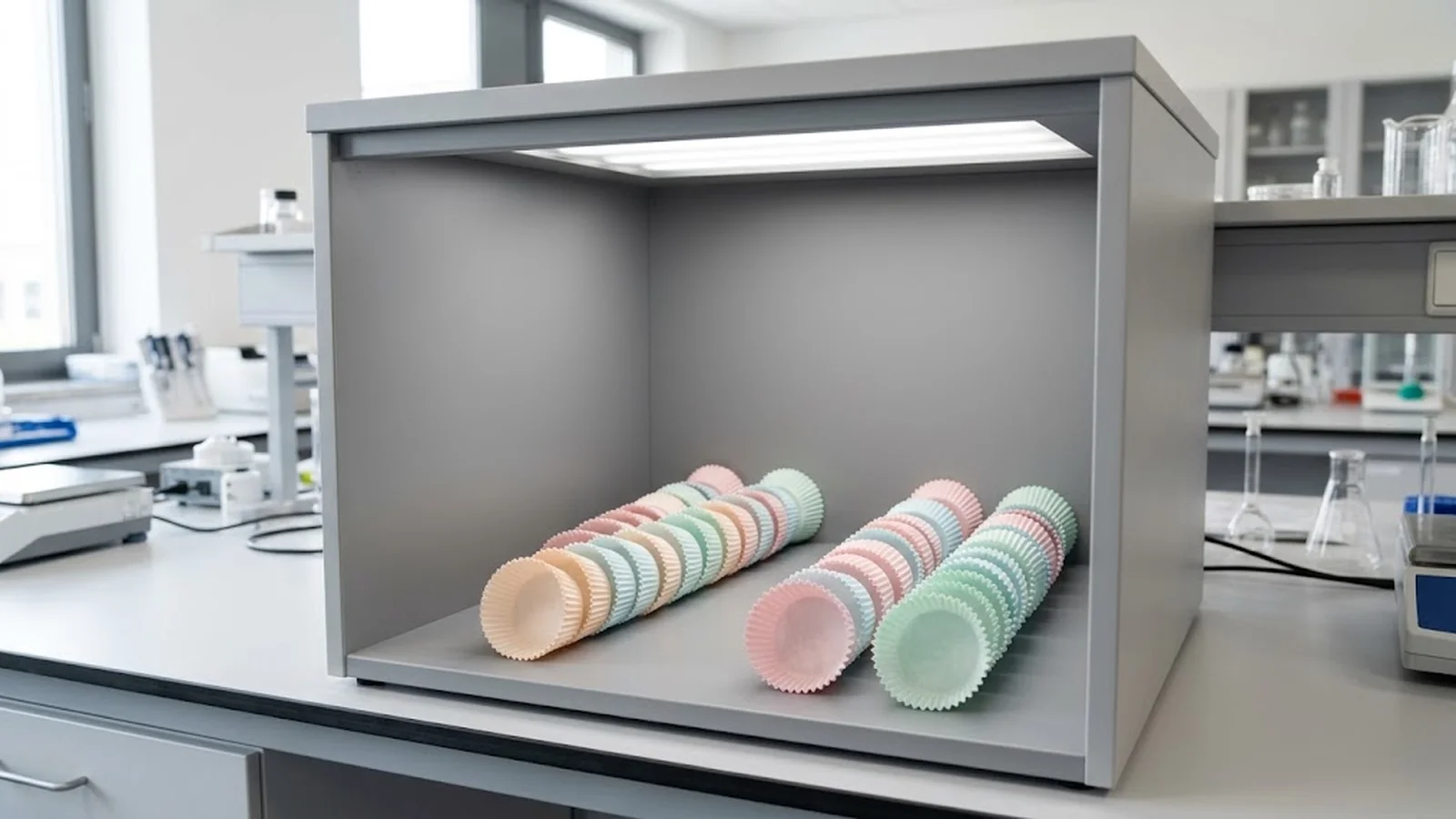
- Metamerism. A color matched under one light source can diverge under another — a cup set that matches in the factory's fluorescent light can split visibly into two shades under the supermarket's cooler LED light. Metamerism is the reason shade must be assessed and approved under defined illumination, typically D65 daylight equivalent.
Also relevant: colored and printed cups sit in the same regulatory frame as the rest of the food contact surface, so color changes should trigger the same compliance review as any other formulation change, including migration considerations for the colorant system. The factory and certificate library lists the third-party audits and test reports behind these claims.
2. Measuring Color: Spectrophotometers and Delta E
Visual matching alone cannot carry a multi-year supply relationship — memory is unreliable and lighting is uncontrollable. The instrument-based standard works like this:
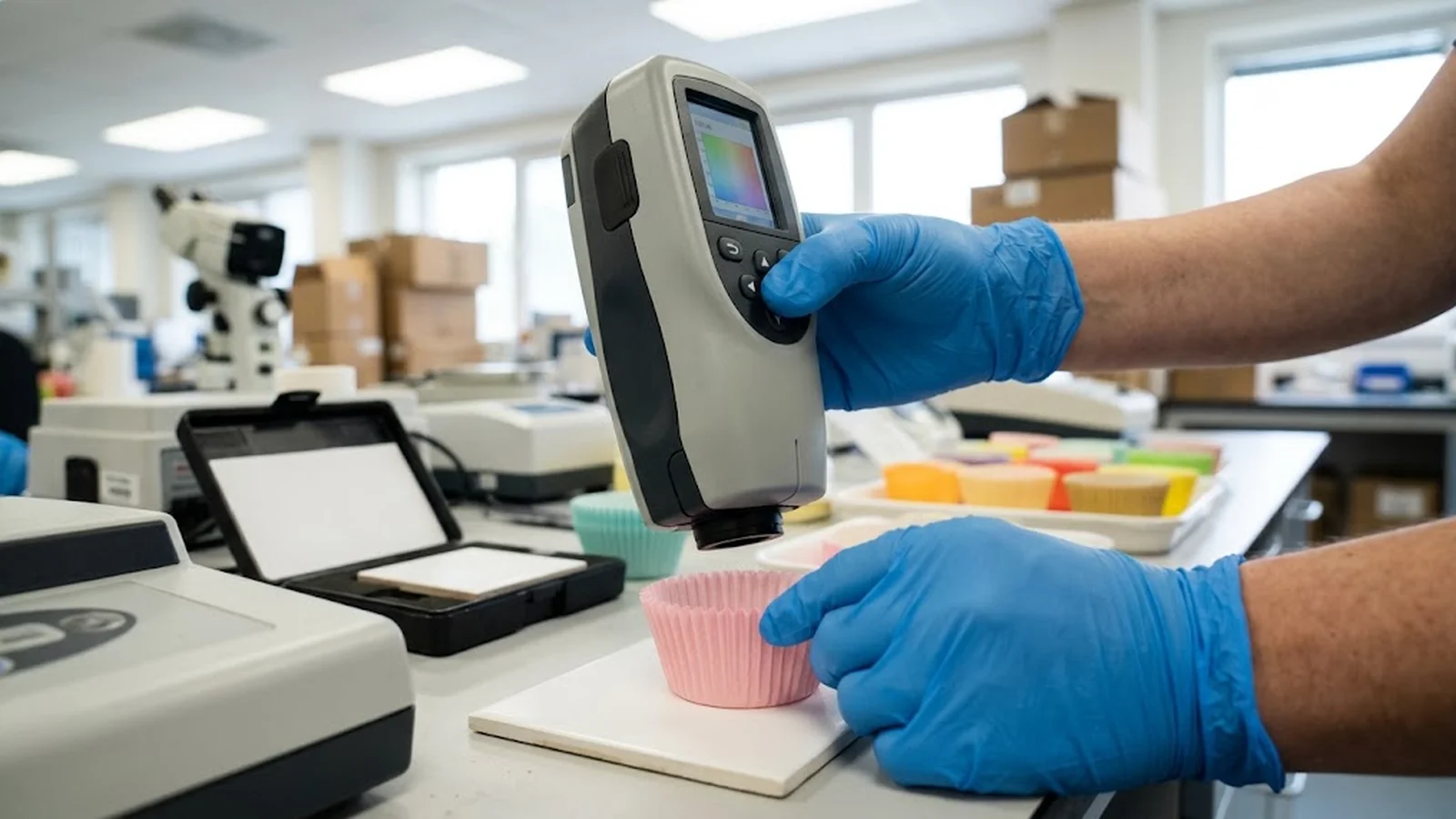
- A spectrophotometer measures light reflected from the cup surface across the visible spectrum and converts it to CIE L\*a\*b\* coordinates: L\* for lightness, a\* for the red–green axis, b\* for the yellow–blue axis.
- Delta E (ΔE) is the distance between a sample's coordinates and the approved master's coordinates — a single number summarizing how different two colors look. Instrument calculations vary slightly between the legacy CIE 1976 formula and the perceptually weighted CIEDE2000; the specification should name which one it uses, because a ΔE of 1.5 means different things in each.
- Measurement discipline matters: cups are measured on a flat fluted surface, so specify the instrument model class, measurement geometry, number of readings per cup (a fluted wall is not uniform — readings should average multiple points) and the master against which results are reported.
Handheld consumer colorimeters are adequate for incoming checks; formal lot acceptance and disputes should use calibrated lab instruments, which third-party inspection services carry as standard equipment.
3. Setting an Acceptable Delta E Tolerance
Tolerances should be realistic: paper coloration is not plastic injection molding, and chasing ΔE below 0.5 across dye lots costs money without a visible return. Practical bands for colored paper cake cups:
- ΔE ≤ 1.0 (CIEDE2000): essentially indistinguishable side by side. Achievable within a single production run and by disciplined suppliers across repeat runs; appropriate for premium retail private label where cups are visible through clear packaging.
- ΔE 1.0–2.0: a difference most trained eyes can detect side by side but few customers notice in separate viewing contexts. Acceptable for most foodservice and standard retail programs.
- ΔE > 2.0: visibly different. Treat as out of specification for any program where the cup appears next to previously shipped stock — mixed inventory on the same shelf is the failure scenario that generates complaints.
Two refinements make the number workable. First, weight the tolerance by axis: small lightness (L\*) drift is less objectionable than hue shift, so many programs set ΔL\* tighter and allow slightly more Δb\* movement. Second, define the comparison basis — measured against the approved physical master stored in controlled conditions, not against a digital file or a sample that has faded in a sunlit office for two years.
4. The Shade Approval Workflow and Incoming Checks
A workable workflow for repeat-order programs:
- Create the master. Approve a signed shade standard — a fixed quantity of cups retained in light-blocking packaging, dated and referenced in the specification. Keep duplicates at both buyer and supplier.
- Write the number in. The specification states the target shade, the ΔE formula, the tolerance band and the instrument conditions — not just "same color as sample."
- Pre-production shade lot sign-off. For new colors or new dye lots, require a production-run sample measured against the master before the full order runs.
- Incoming verification per shipment. Measure five cups from the shipment against the master with a handheld device, record ΔE per cup and the average, and log it alongside dimensional and grammage checks. Reject or quarantine when the average breaches tolerance.
- Watch trends, not just gates. A supplier passing at ΔE 1.8 every shipment is drifting; the log that shows it turning 1.2 → 1.5 → 1.8 is the early warning that opens a dye-lot conversation before the rejection happens.
Buyers who keep the same master for years should periodically verify the master itself against retained production samples — standards age too.
FAQ
What Delta E tolerance should I set for colored cake cups?
For most wholesale programs, ΔE ≤ 2.0 (CIEDE2000) against the approved master is a workable acceptance band, with ΔE ≤ 1.0 for premium retail where cups display side by side through clear packaging. Name the formula, the instrument conditions and the physical master in the specification — a tolerance without those definitions is unenforceable.
Why does the same cup color look different in my store than in the factory?
Two reasons: lighting and metamerism. Colors match under one light source and split under another, so a pair approved under warm factory light can diverge under cool retail LED. Approve and measure shade under a defined standard illuminant such as D65, and check retail environments with a light booth if shelf appearance is critical.
Do I need a spectrophotometer to control color consistency?
Not necessarily. A handheld colorimeter costing a few hundred dollars is sufficient for incoming checks against the master; full lab spectrophotometers matter for formal lot acceptance and disputes. The essential pieces at any budget level are a retained physical master, a defined measurement routine and a logged ΔE history per supplier.
Conclusion
Color consistency is a specification problem, not a luck problem. Approve a retained physical master, write a numeric Delta E tolerance with the formula and measurement conditions named, verify each shipment against the master, and trend the log so drift is caught before customers see it. Buyers who treat shade as a measured parameter get cups that look like the same product across every order — which is what the brand, and the customer, assumed they were buying. Buyers standardising on one paper supplier can review our food-grade die-cut parchment rounds next to their cup specifications.
CTA
LANGMAI manufactures colored and custom-printed cake cups with batch-to-batch shade controlled against retained master standards and verified by spectrophotometer ΔE measurement. اتصل بنا our wholesale team with your target shades and program requirements for shade-matched samples and a color-controlled quotation.
Sources
- CIE — Colorimetry standards and illuminants
- ASTM D2244 — Standard Practice for Calculation of Color Tolerances and Color Differences from Instrumentally Measured Color Coordinates
- ISO 11664 — Colorimetry: CIE color spaces
- FDA — 21 CFR Part 176 Indirect Food Additives: Paper and Paperboard Components
- EU Regulation 1935/2004 — Materials and articles intended to come into contact with food