
Introduction
To source cake boards wholesale reliably, define six things before you approve samples: finished cake size, expected load, whether food touches the board surface or only a separate liner, the board construction, the sales channel, and the packaging hierarchy from consumer unit to pallet. If those six points are clear, buyers can compare suppliers on facts instead of on photos alone.
That sequence matters because cake boards are easy to underestimate. A board that looks acceptable in a catalog may flex too much under a chilled cake, arrive with scuffed edges, use a surface that was not reviewed for the buyer's intended food-contact use, or ship in a case format that does not fit retailer or warehouse data. Wholesale cake board buying is therefore a specification and handling decision, not only a color or shape decision.
This guide is written for bakery-supply importers, supermarket private-label teams, event wholesalers, ecommerce brands and homeware buyers. It focuses on practical B2B decisions: when a round or square board is more useful, how to describe board construction, what to confirm if the top surface may contact food, how to test stability, how to set retail-pack and carton rules, and how to inspect the shipment before release.
1. Start with the commercial job of the board
Cake boards are used in several different selling environments, and each one changes the specification priority.
| Channel or use case | Main buyer priority | What that changes in the specification |
|---|---|---|
| Bakery counter or custom-cake shop | Presentation, stability during pickup, clean edge finish | Board diameter, thickness, edge wrap, top-surface finish |
| Supermarket private label | Retail pack clarity, barcode control, repeatable pack count | Consumer unit, GTIN ownership, case count, pallet pattern |
| Event and party wholesale | Mixed-order flexibility and coordinated accessories | Assortment planning, color range, pack mix, shelf-ready handling |
| Ecommerce or parcel retail | Transit durability and clean arrival | Inner protection, crush resistance, parcel-style handling checks |
| Foodservice or catering supply | Fast replenishment and predictable case specs | Bulk case quantity, dimensions, gross weight and warehouse labeling |
Before requesting a quote, write a short intended-use line. Example: "Round silver paper cake boards for chilled celebration cakes up to 8 inches, sold in retail packs of 12 into the US market." A supplier can work with that. "Cake board price please" is not enough.
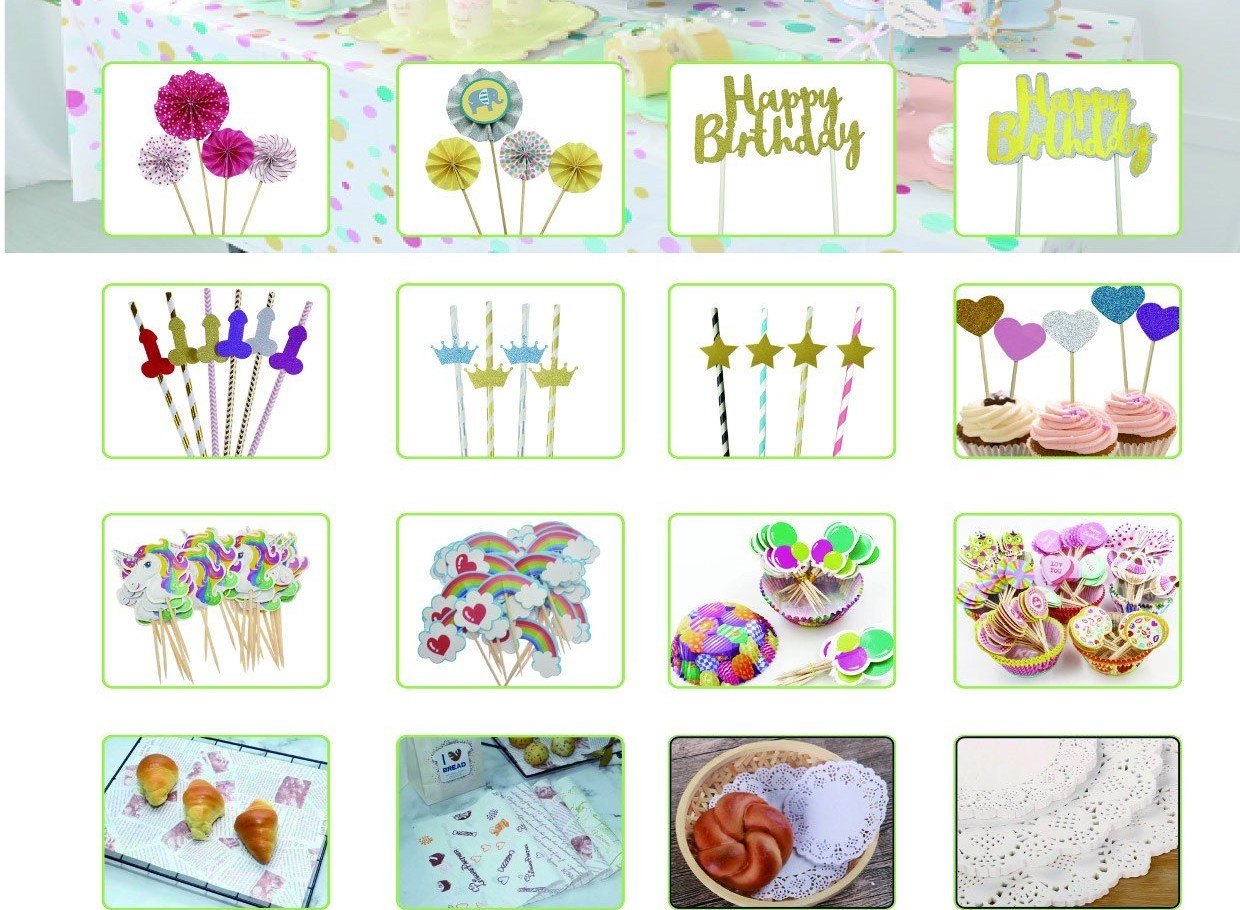
If the board is part of a broader celebration range, LANGMAI's party accessories page shows that cake boards are handled within its paper-party category rather than as a stand-alone published product line. Buyers should therefore confirm the exact board style, finish and packaging route for the planned order instead of assuming every catalog image represents a current stock item.
2. Define the board by size, shape and construction
Most procurement mistakes start with vague product naming. "8-inch cake board" does not fully define the item, because buyers still need the true finished diameter or side length, thickness or ply structure, edge treatment, top finish and bottom finish.
Use a specification table like this when sending an RFQ:
| Field | What to define |
|---|---|
| Shape | Round, square, rectangle or custom die-cut |
| Finished size | Diameter or side length, and tolerance if the buyer uses one |
| Construction | Paperboard or laminated paperboard construction as quoted by the supplier |
| Surface finish | Printed, foil-look, plain, embossed or other approved finish |
| Edge style | Wrapped edge, exposed edge or other approved structure |
| Intended load | Finished cake or dessert weight range to be sampled |
| Food-contact scenario | Direct contact, indirect contact, or used under a separate liner/sheet |
| Sales format | Bulk, retail pack, private label, mixed set or shelf-ready case |
For buyers who also purchase cupcake toppers, doilies or themed tableware, the party range planning guide is useful for assortment logic. This article is narrower: it is about choosing the cake board itself.
Do not assume that a decorative finish automatically changes the structural performance in a predictable way. A thicker-looking board can still flex more than expected if the internal construction differs. Sample testing remains necessary.
3. Separate direct food contact from display-only use
Some cake boards are used under a separate liner, mat or greaseproof sheet. Others may touch the baked good, icing or pastry base directly. That difference matters because compliance review depends on the actual intended contact.
The European Commission's current food-contact overview states that food contact materials include packaging, kitchenware and tableware, and that constituents transferring from those materials can affect health, taste, smell or appearance. The Commission also states that all food contact materials placed on the European market must comply with Regulation (EC) No 1935/2004 and must be manufactured according to Good Manufacturing Practice under Regulation (EC) No 2023/2006. See the Commission's official Food اتصل بنا Materials page.
For US projects, FDA explains that the overall regulatory status of a food-contact article depends on the status of each individual substance that comprises the article when that substance is reasonably expected to migrate to food. FDA also notes that an effective Food اتصل بنا Substance Notification applies to the named manufacturer, the specific substance and the stated conditions of use, not automatically to a similar substance from another source. See FDA's official page on Determining the Regulatory Status of Components of a Food اتصل بنا Material.
The practical buying rule is simple:
- If the cake or dessert may touch the board surface, ask the supplier what exact construction and surface are being reviewed for that intended use.
- If a liner or doily always separates food from the board, state that in the specification instead of letting the supplier guess.
- If the project includes printed, coated or laminated surfaces, confirm the exact finished version being quoted, not only the unprinted base board.
This avoids a common mistake: treating a generic "food safe" statement as universal evidence for every finish, adhesive, laminate, print treatment or application.
4. Match the board to the real load and service conditions
Cake boards are not chosen by diameter alone. Buyers need to consider what happens between finishing, chilling, boxing, transport, shelf display and final handoff.
Questions that change the required stability include:
- Is the cake buttercream, mousse, cheesecake or a dry sponge?
- Will it be refrigerated, frozen or held at room temperature?
- Is the board mainly for carrying, for retail display, or for both?
- Will the board be inserted into a box with side support, or used on its own?
- Does the seller need the edge to remain visually clean for photography or shelf display?
FDA's food types and conditions-of-use tables are helpful here because they remind buyers that food-contact review is linked to the type of food and use condition. The tables distinguish bakery products with and without free surface fat or oil, and separately identify use conditions such as refrigerated storage, frozen storage and cooking above 250 degrees Fahrenheit. See FDA's official Food Types & Conditions of Use for Food اتصل بنا Substances.
For procurement, that means a board used only under a chilled decorated cake is not the same review as one exposed to warm bakery items or reheated service. Even when the product name stays the same, the intended use should be written into the quote file and sample plan.
5. Ask for sample tests that reflect real handling
Cake board sample approval should go beyond visual inspection. The board needs to survive the buyer's actual workflow.
Use a sample checklist such as:
- confirm finished diameter or side length against the approved drawing;
- inspect top and bottom surface quality under ordinary retail lighting;
- check edge wrap, corners and delamination risk;
- place a representative cake or test weight on the board;
- lift, rotate and box the product as it would be handled in normal service;
- check flex, visible edge damage and surface marking after handling;
- test stacked retail packs or bulk bundles for scuffing and compression;
- photograph approved and rejected conditions for repeat orders.
Do not turn one successful sample into an unlimited performance claim. Record the tested product, weight, storage condition and handling method. That gives the next buyer or inspector a stable reference.
Need help matching cake boards with coordinated baking or party paper items? Buyers can review LANGMAI's party accessories range and customization workflow before sending board sizes, finish references and pack-count requirements.
Discuss Your Cake Board Project
6. Build the packaging hierarchy before artwork approval
Many cake board problems are packaging problems. Boards can arrive with bent edges, rubbed surfaces or unstable retail stacks even when the board itself was manufactured correctly.
Define the packaging hierarchy in four levels:
| Packaging level | What to lock |
|---|---|
| Consumer unit | Count, finish visibility, barcode area, mandatory text, opening style |
| Inner pack | Stack quantity, wrap or sleeve, anti-scuff protection, separator use |
| Master case | Case count, carton dimensions, gross weight, orientation and marks |
| Pallet or logistics unit | مشاريع per layer, layers per pallet, maximum height, wrap method |
If the project uses retail packs, GTIN and case hierarchy must be assigned intentionally. GS1's GTIN Management Standard states that a change to the number of trade items in a case, or a change to the number of cases in a predefined pallet configuration, requires a new GTIN at the affected higher packaging level. See GS1's official GTIN Management Standard and its pack/case quantity rule.
The practical point for buyers is that pack count and case count are not late-stage details. If a supermarket team changes from 12 boards per retail pack to 10, or from 24 retail units per case to 20, the packaging data and often the barcode hierarchy need to be reviewed again.
7. Compare suppliers with an evidence-based scorecard
Cake board quotes are easier to compare when buyers ask every supplier the same set of questions.
| Evaluation area | Evidence to request | Warning sign |
|---|---|---|
| Product definition | Drawing, board size list, finish and edge description | Photo-only quotation with no construction detail |
| Food-contact support | Intended-use statement and document scope for the exact finished version | Generic "food grade" wording with no scope explanation |
| Stability testing | Sample plan tied to realistic cake weights and handling | Supplier says testing is unnecessary |
| Packaging control | Retail pack, inner pack, case and pallet proposal | Packaging discussed only after order placement |
| Repeat-order control | Versioned artwork, product code, retained sample and change notice | No revision control for finish or pack count |
| Shipment inspection | Pre-shipment checks, photos and carton verification | Release based only on carton quantity |
Buyers should also ask whether the supplier can handle mixed orders with coordinated accessories if the board is part of a larger event or bakery range. That is relevant for importers and event wholesalers, but it should not replace the need to define the board itself clearly.
8. Prepare the RFQ with the details suppliers actually need
A quote-ready RFQ for cake boards should include:
- shape, size and target finish;
- intended use and whether direct food contact is expected;
- estimated load or representative cake size;
- target market and sales channel;
- consumer pack count or bulk case requirement;
- barcode ownership and labeling responsibility if retail packed;
- carton and pallet preferences;
- sample quantities and approval route;
- artwork status if branded or private label;
- requested shipment photos or inspection points.
If the buyer has a reference sample, send photos of the top surface, underside, edge and packed unit. A top-view photo alone rarely answers the important procurement questions.
9. Inspect the shipment against the approved pack-out
Cake board shipment inspection should connect the physical goods to the approved sample and packaging file.
Check at minimum:
- SKU, finish version and dimensions against the approved sample;
- stack count per retail unit, inner bundle and master carton;
- edge integrity, delamination, dents, wrinkles and visible abrasion;
- carton quantity, dimensions, weight and shipping marks;
- barcode and label correctness where applicable;
- pallet count and stability if the pallet configuration was specified;
- retained photos from random opened cartons, not only outer labels.
For parcel or ecommerce programs, run a practical transport check on the actual packed unit. For wholesale store delivery, confirm case handling and pallet stability. The correct test depends on the route, so buyers should avoid copying an unrelated transport requirement without checking whether it fits the real channel.
For broader shipment-control thinking, LANGMAI's baking paper quality-control guide gives a useful inspection mindset that can be adapted to accessory items and mixed paper-product orders.
FAQ
Are cake boards always direct food-contact products?
No. Some boards are used with a separate liner or doily, while others may touch the cake or dessert directly. Buyers should define the actual use case and review the exact finished construction against that intended use instead of assuming one answer fits every board.
What should buyers confirm first when sourcing cake boards wholesale?
Start with shape, finished size, intended load, food-contact scenario and packaging format. Those points determine which samples, documents and packaging hierarchy need to be reviewed.
Does a different retail pack count matter for GTIN control?
Yes. GS1's pack and case quantity rules mean that a change in the number of trade items in a case, or a change in a predefined pallet quantity, can require a new GTIN at the affected higher packaging level. Buyers should confirm the exact rule with their GS1 or retailer process.
Can a supplier decide whether a decorative board is suitable for direct food contact?
The supplier can explain the quoted construction and available evidence, but the buyer should still define the intended use and confirm that the exact finished version being ordered matches that review. Decorative finish alone does not prove suitability for every application.
How should cake boards be sampled for load support?
Use representative cake weight or a defined substitute, then test lifting, rotating, boxing and display handling under the real storage condition. Record the tested configuration instead of turning one sample result into a universal performance claim.
What is the biggest mistake in cake board procurement?
Treating the board as a simple decorative item. Most avoidable failures come from missing construction details, unclear food-contact assumptions, weak pack-out planning or shipment inspection that checks cartons but not the actual stacked boards.
CTA
Send LANGMAI your target cake size, board shape, finish reference, intended food-contact use, retail or bulk pack requirement, target market and annual volume. The team can review whether the requested board fits its party-accessories production route and discuss samples, packaging and quotation scope.
Conclusion
Buying cake boards wholesale is a combined product, packaging and handling decision. The best results come from defining the board by size, construction, intended load, food-contact scenario and packaging hierarchy before samples are approved. That makes supplier quotations comparable and reduces avoidable failures such as flexing, edge damage, barcode confusion and unstable case counts.
For bakery and celebration buyers, the real test is whether the approved board still performs after packing, transport and final presentation. When the sample plan, document scope and carton spec all match the intended use, the order is much easier to scale with confidence.