
Introduction
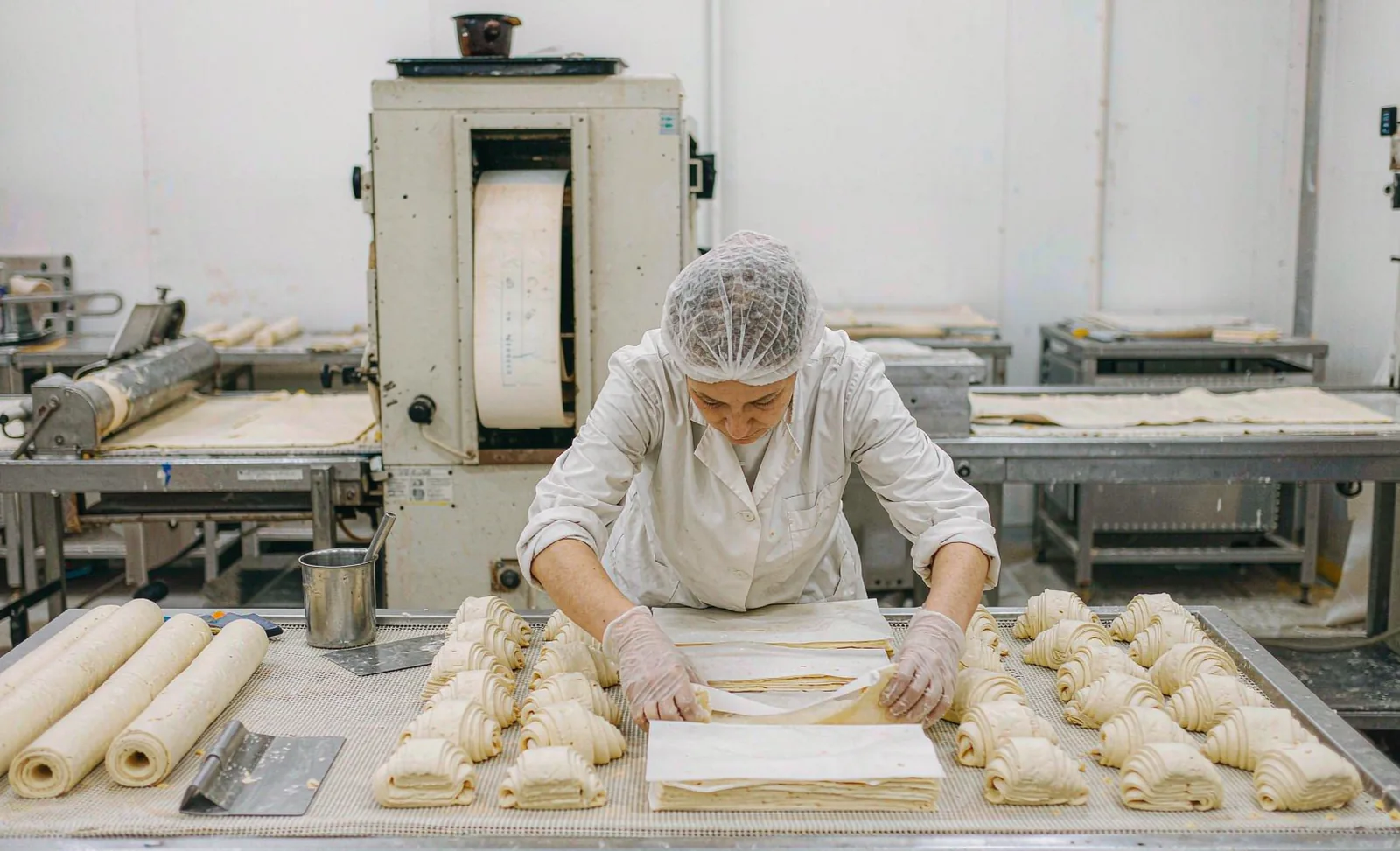
Industrial croissant and laminated dough production puts unusual demands on baking paper. The dough contains layers of butter, the process passes repeatedly through cold rooms and freezers, and the same sheets may be used as release liners during lamination, as interleaves between dough blanks and as baking liners at the oven. A paper that performs well in a small bakery can fail on a production line through curling in the freezer, sticking under butter-rich dough, or jamming in automatic dispensing equipment. Buyers comparing these specifications can review our wholesale parchment paper rolls and sheets programme, where coating weight, base grammage and release values are documented per construction.
This guide explains where baking paper sits in a laminated dough line, how to choose between single-side and double-side silicone papers, what to check for cold-chain performance, and how to buy the right grammages, sizes and formats at wholesale volume without slowing the line down. Buyers verifying these specifications can review the certificate library alongside supplier documentation requests.
1. Where Baking Paper Sits in a Laminated Dough Line
In a typical croissant line, paper appears at four points:
- Lamination release. Sheets or rolls separate dough blocks during sheeting and folding steps, preventing the fat layers from welding to equipment or to each other.
- Resting and retarding. Stacked dough sheets rest on paper in the cold room while the butter firms up; the paper must stay flat and release cleanly after hours of chilling.
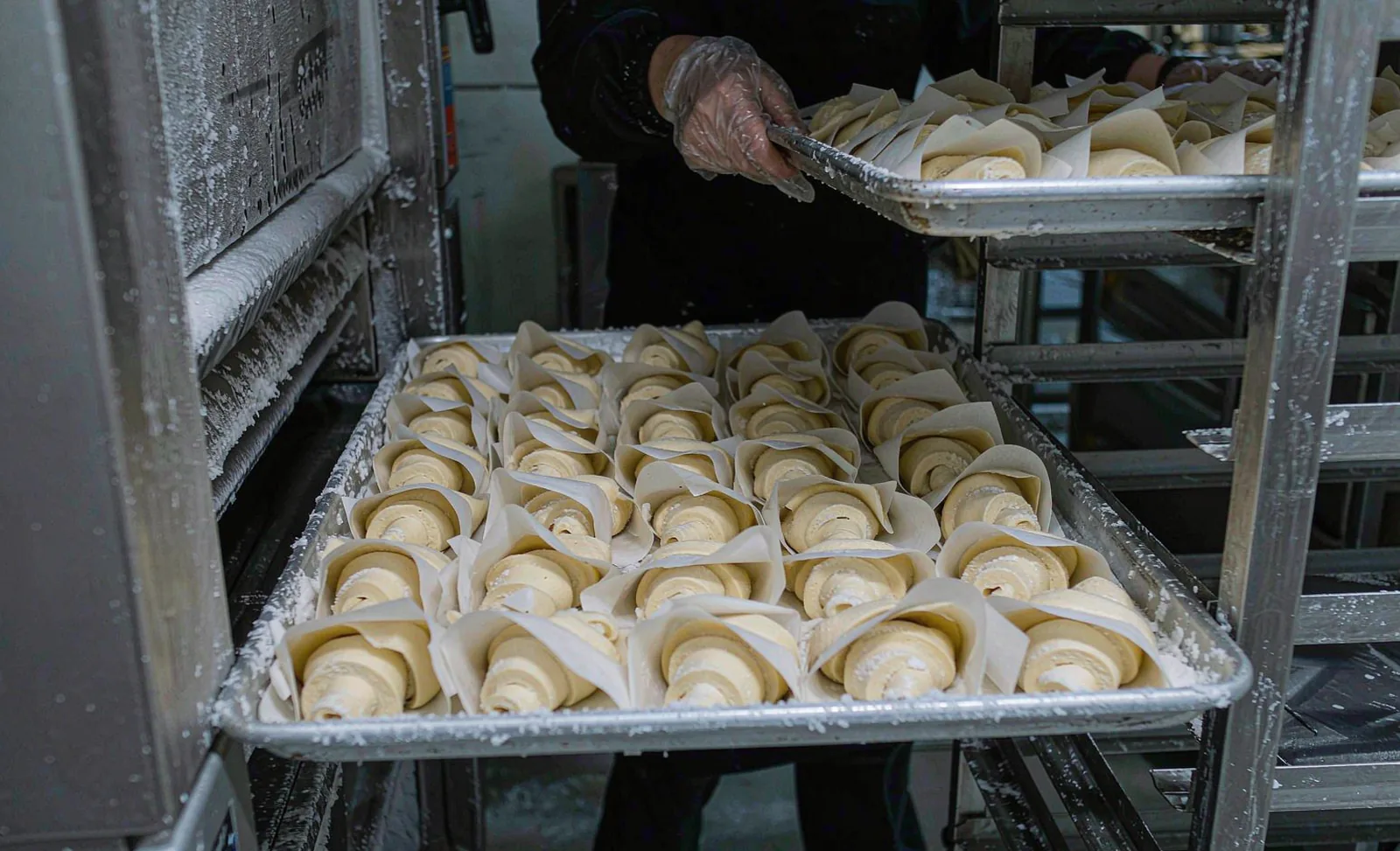
- Interleaving and freezing. Shaped dough pieces are separated by paper sheets so they can be proofed, frozen and packed without touching. In frozen distribution, the interleave often travels all the way to the end user.
- Baking. Finished croissants bake on trays or in tins lined with baking paper, then leave on the paper for cooling and display.
Each use has different priorities. Lamination and retarding punish paper that curls or sticks under fat; interleaving demands exact dimensions and clean dispensing; baking demands release and heat performance. Buyers should define the uses separately instead of specifying one "universal" sheet for the whole line. For production volumes, the same construction logic applies to our baking parchment paper manufacturing programme line, quoted per roll, sheet or die-cut format.
2. Double-Side Silicone Paper vs Single-Side for Interleaving
The most common technical question is whether to use single-side or double-side silicone treatment.
| Criterion | Single-side silicone | Double-side silicone |
|---|---|---|
| Release under butter-rich dough | Only reliable if orientation is controlled | Reliable regardless of which face touches dough |
| Roll or sheet curl | Higher tendency to curl; can jam dispensers | More balanced, lies flatter after conditioning |
| Freezer interleaving | Risk of the uncoated face adhering to a wet dough surface | Consistent separation on both faces |
| Cost | Lower; suits one-directional uses | Higher; justified where orientation cannot be guaranteed |
| Typical fit | Tray liners, base layers, baking-only uses | Lamination release, interleaves, frozen dough |
For automated croissant lines and frozen dough programs, double-side silicone is the safer default. Automatic sheet dispensers and interleaving machines cannot guarantee that a single-side sheet lands with the treated face down, and one flipped sheet can stop the line. The added cost per sheet is usually small compared with a single stoppage or a batch of croissants welded to their neighbors.
Silicone treatment does not change regulatory status by itself. Food-contact evidence must cover the base paper, the silicone system and any additives for the intended food type and temperature; the FDA food types and conditions of use tables distinguish bakery products by surface fat and high-temperature use, and in the EU Regulation (EC) No 1935/2004 applies the general safety and traceability framework.
3. Cold Room and Freezer Performance
Laminated dough lives in the cold chain, and paper must survive it. Test candidate papers under the real cycle, not at room temperature:
- Condensation and moisture. Moving dough from retarder to freezer creates condensation; the interleave must not blister or delaminate when wet on one face.
- Curl after freezing. Sheets removed from a freezer should lie flat enough to dispense. Curl is often worse at low temperature than at room temperature.
- Release after freezing. Frozen dough surfaces are sticky; the paper must peel cleanly without tearing or lifting dough skin.
- Embrittlement. Low-grammage papers can stiffen and crack when folded cold; check fold points on interleaved formats.
A practical protocol: run a full retarding, freezing, thawing and baking cycle with at least three lots of the candidate paper, record release quality, curl direction, tear behavior and any dough contamination, then compare against the incumbent paper under identical conditions.
4. Grammage, Dimensions and Formats
Match the format to the use:
| Use | Typical grammage range | Format | Key dimensions to fix |
|---|---|---|---|
| Lamination release | 40–60 g/m² | Sheets or roll | Sheet size to dough sheet plus overhang; roll width and core |
| Cold room stacking | 40–60 g/m² | Sheets | Tray footprint, stacking height |
| Dough interleaving | 35–50 g/m² | Cut sheets on dispensers | Exact sheet size, count per pack, dispenser compatibility |
| Baking liner | 38–45 g/m² | Sheets, roll or pre-cut | Tray size, oven band width |
| Wrapping finished product | 35–45 g/m² | Sheets or rolls | Presentation size, print or plain |
Fix the dimensions with tolerances and count per carton, and state whether the dispenser feed edge is cut. For interleaving on automated lines, paper that is 1–2 mm too wide or too stiff will misfeed; these tolerances are production parameters, not cosmetic details. More background on specifying basis weight and test methods is in the baking paper grammage buyer guide.
5. Dough Transfer and Line Efficiency
Paper choice affects throughput in ways that show up in cost accounting:
- Transfer speed. A flat, balanced sheet lets operators or suction systems move dough stacks quickly; curled sheets slow every transfer.
- Re-use decisions. Some lines re-use release sheets within a shift. If re-use is planned, specify grease resistance and stiffness that survive several contacts with fat, and define the discard rule.
- Waste rate. Misfeeds, double-sheet pickup and torn interleaves are waste. Track waste per shift before and after a paper change; the sheet price difference often disappears when waste is counted.
- Oven turnaround. Liners that release cleanly reduce tray washing and damage to delicate proofed dough.
Ask the supplier for roll lengths and pack counts that match changeover intervals, so operators are not splicing new rolls mid-run.
6. Wholesale Buying Checklist
Before requesting quotations, prepare:
- Each use point in the line and the paper format for each.
- Single-side or double-side silicone decision per use.
- Grammage range and tolerance per format, with the test method.
- Exact sheet dimensions, tolerances and count per pack or roll.
- The cold-chain cycle the paper must survive, with your test protocol.
- Food-contact documentation required for your market.
- Monthly volume, packaging preference and pallet configuration.
- Sample quantities for line trials before the first production order.
Run a line trial with at least one full shift, record release, waste, misfeeds and freezer behavior, and only then commit to a volume price.
FAQ
Why is double-side silicone paper recommended for croissant production?
Laminated dough is high in fat and the line cannot control which face of a sheet touches the dough. Double-side silicone gives consistent release and lies flatter in the cold chain, which matters for automated dispensing and freezing.
Can the same paper be used for lamination and for baking?
Sometimes, but the uses have different priorities. Lamination favors release under fat and flatness; baking favors heat performance. One sheet can serve both if it passes trials at each station, but many lines use two formats.
Does freezing damage baking paper?
Paper itself is not damaged by freezing, but condensation and low temperature can cause curl, wet-strength loss and misfeeding. Test the complete retarding-freezing-thawing cycle before approving a sheet.
What grammage is typical for dough interleaving?
Around 35–50 g/m² depending on dough weight and dispenser design. Lighter sheets dispense better but must resist tearing when separating frozen dough pieces.
How many samples should we test before ordering wholesale?
Run at least three production lots through a full shift trial, because silicone application and curl can vary between lots. Compare against your current paper under identical conditions.
Conclusion
Baking paper in croissant and laminated dough production is a process component, not an accessory. Define each use point separately, default to double-side silicone where orientation or the cold chain is involved, fix grammage and dimensions with tolerances, and test the complete cold-chain cycle before committing to volume. Buyers who specify this way get paper that runs quietly on the line and a supplier who can reproduce it lot after lot. Our private-label parchment paper supplier programme publishes the test data behind each grade so specifications can be verified before ordering.
CTA
LANGMAI manufactures double-side and single-side silicone baking paper in custom grammages, sheet sizes and roll formats for croissant, laminated dough and frozen dough lines. Send LANGMAI your line layout, dough weight, cold-chain cycle and monthly volume to receive matched samples for a full line trial and a wholesale quotation.
Request Croissant Line Samples
Sources
- FDA — Food Types and Conditions of Use for Food اتصل بنا Substances: https://www.fda.gov/food/packaging-food-contact-substances-fcs/food-types-conditions-use-food-contact-substances
- European Commission / EUR-Lex — Regulation (EC) No 1935/2004 on food contact materials: https://eur-lex.europa.eu/eli/reg/2004/1935/oj
- EFSA — Food contact materials assessments and guidance: https://www.efsa.europa.eu/
- ISO — ISO 22000 Food safety management systems: https://www.iso.org/standard/71726.html