Introduction
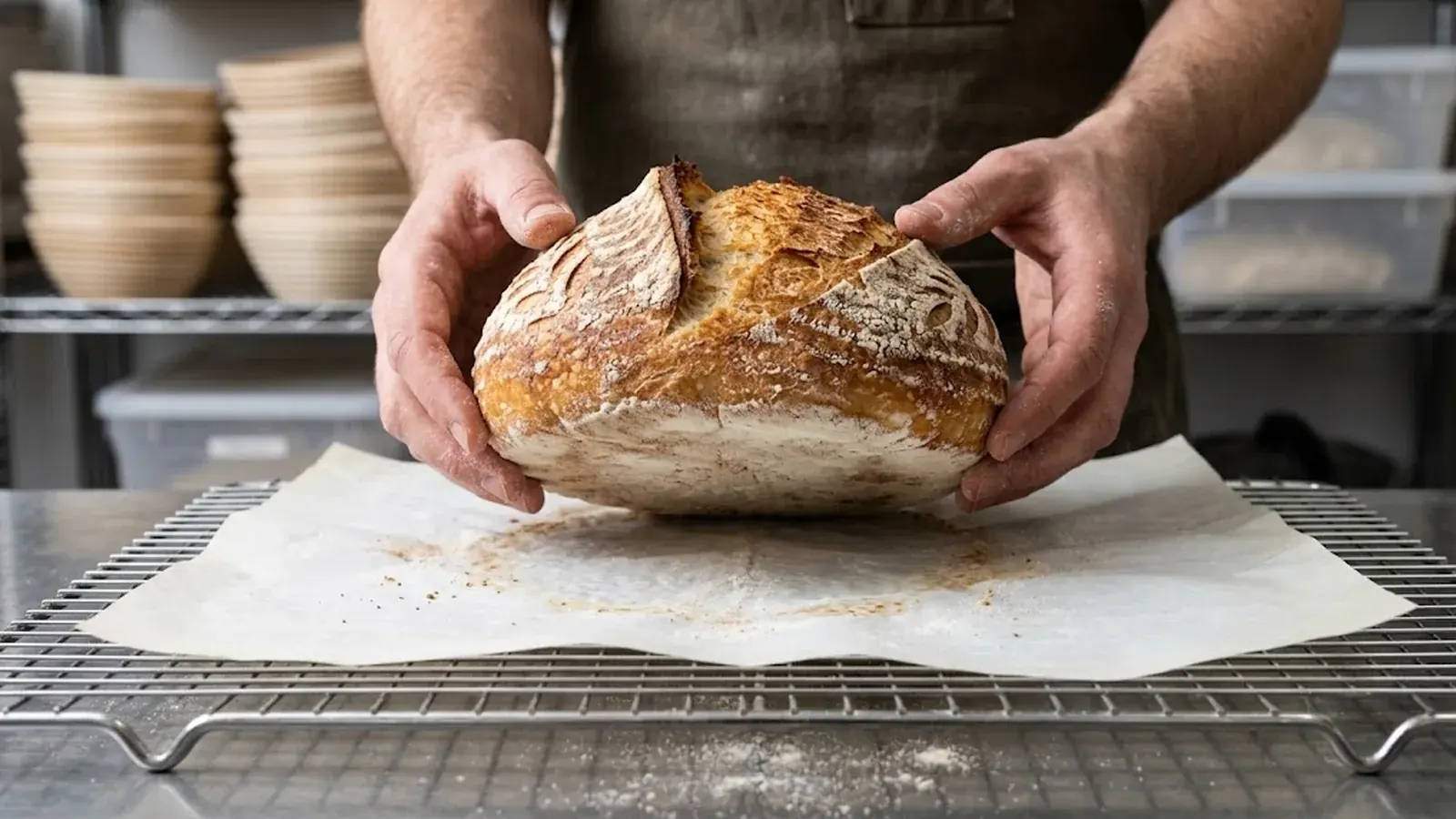
Sourdough is the least forgiving baked product for a paper liner. A shaped loaf at 75-85% hydration is sticky, acidic and slow-fermenting, and in most artisan bakeries it spends hours on a proofing surface before it ever reaches the oven. The liner then has to do three jobs at once: release a wet, sugar- and acid-rich dough without tearing the crust, survive a long bake at high deck temperature with steam, and stay flat through fast manual or automated loading. Buyers comparing these specifications can review our pre-cut parchment paper sheets and rounds programme, where coating weight, base grammage and release values are documented per construction.
Most buyers discover the gap between a sample and production the same way. A single sheet trial at the bench releases cleanly, so the order is placed; three weeks later a handful of loaves per batch weld to the paper, or the sheet cockles in the steam and leaves a ribbed mark on the base. Both problems come from the same place, a liner chosen for grammage and price rather than for the release, heat and moisture conditions of a sourdough line. Buyers verifying these specifications can review the certificate library alongside supplier documentation requests.
This guide explains how coated and parchmentised papers behave across a professional sourdough workflow, how proofing surfaces and bake liners differ, and what to write into a specification so the sample that released in your test bakery still releases in every container.
LANGMAI manufactures baking paper, cake cups and food packaging paper for wholesale buyers, including silicone-coated liners and cut sheets for artisan and industrial bread production.
Why Sourdough Punishes Paper More Than Standard Bread
Three product properties push paper past its comfort zone:
- High hydration and free water. Lean bread at 65% hydration is comparatively dry at the surface. Sourdough at 75-85%, and especially long cold-retarded dough, keeps free water and dissolved sugars at the interface with the liner. Water softens the sheet, and sugars caramelise against it, so the peel force at the end of the bake is higher than in conventional pan bread.
- Acidity. A mature starter produces organic acids that hold dough pH well below that of yeasted dough. Over a long proof, that acidic film interacts with the liner surface and can dull a release layer faster than a neutral dough.
- Long, hot bakes with steam. Sourdough loaves typically bake longer, often with injected steam at the start. Steam plus a 230-260 degrees C deck is a demanding combination: the sheet absorbs moisture, then dries and can shrink against the pan, and any weakness in the coating shows up as a stuck patch.
The practical consequence is that release is a system property, not a paper property. Hydration, retard time, pan material, steam schedule and liner coating act together, and a liner that works on one formula can fail on another in the same bakery. For production volumes, the same construction logic applies to our custom printed baking parchment paper line, quoted per roll, sheet or die-cut format.
Proofing Surfaces and Bake Liners Are Different Jobs
A sourdough workflow usually needs two paper decisions, and buyers who treat them as one often over-specify one stage and under-specify the other.
Proofing. Shaped loaves are typically proofed in a linen couche, on a floured board or in bannetons, then transferred to the bake surface. Paper's role here is usually to protect trays, catch flour and keep wet dough off painted or galvanised surfaces. A plain sheet with moderate moisture resistance is enough; a high-performance silicone coating is wasted because the paper is discarded before the bake. Where trays are proofed in a cold room, however, the paper must stay intact through a high-humidity chilled environment, and a sheet that weakens when wet will tear during transfer.
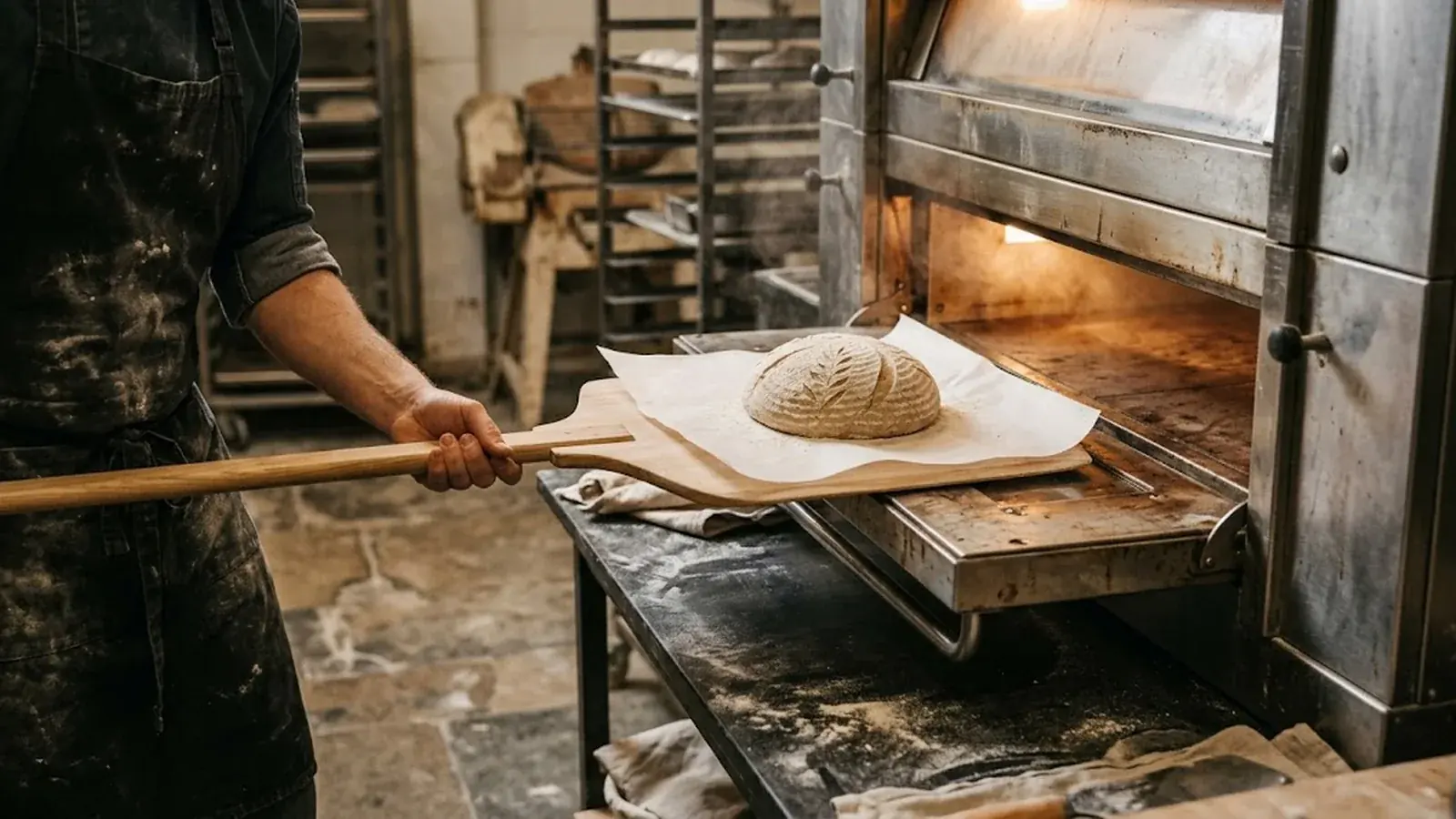
Baking. Here the coating is the whole point. The liner carries the loaf into a deck, rack or conveyor oven, holds the base flat through steam, and releases without pulling crumb. This is where coated papers earn their cost.
Mapping the workflow first, then specifying each stage separately, usually removes more cost than switching to a cheaper universal sheet.
Choosing Coatings for High-Hydration Bake Liners
Three families dominate professional bread baking:
- Silicone-coated paper. A base sheet with one or two silicone layers. Single-sided is common where only the dough face must release; double-sided helps when the sheet doubles as a proofing and baking liner. Release is excellent and heat resistance is high, but coat weight, cure quality and base-sheet formation determine how consistently the sheet releases.
- Vegetable parchment. Wet strength and release come from a partial cellulose conversion rather than a coating. It tolerates moisture and heavy loads well and is often chosen for wet or wrapped handling. Release is good, but behaviour in very long, very hot bakes differs from a silicone system.
- Greaseproof with a light release treatment. Lower cost and adequate for short, low-hydration items, but a poor fit for long sourdough bakes where wet dough sits on the sheet for 40-60 minutes.
Two specification traps matter most. First, coat weight versus bake count: a heavier coat buys more re-use cycles only if the base sheet also has the wet strength to survive handling and cleaning. Second, coating continuity: pinholes and edge gaps, not average coat weight, cause the stuck patches buyers see. Ask the supplier to state coat weight and describe how coating continuity is controlled, then check it in incoming lots rather than trusting the sample.
Sheet Size, Format and Pan Coverage
Format decisions look administrative but affect release as much as chemistry:
- Cut sheets matched to the pan footprint. A sheet that is too large folds up the pan wall; the crease traps steam, dries hard and can lift the loaf base unevenly.
- Rolls for variable formats. Baguette and batard production on mixed pans is usually better served by a roll in the pan width, cut to length at the bench, than by a single stocked sheet size.
- Perforated liners. Where a bakery wants a drier base on a high-hydration loaf, controlled perforation lets steam escape under the loaf. Perforation is a deliberate release-and-crust trade-off, not a universal upgrade, and must be trialled against the specific base colour target.
- Interleaved stacks and dispenser packs. In a busy bakery, handling speed decides whether paper is used correctly. Sheet-to-sheet interleaving or a pop-up dispenser reduces double-sheeting and misfeeding on automated lines.
Trialling Release Like a Production Problem
A release trial at the bench proves very little. Run it as a production problem:
- Use the real formula at real hydration. Take the actual dough at the actual retard time; a fresh, low-hydration test dough flatters every liner.
- Match the oven and steam schedule used in production, and bake at the top of the normal time range rather than an average.
- Score release objectively. Count stuck patches per sheet, note whether crumb tears or the base leaves a residue, and record the sheet's condition after the bake. Cockling, discolouration and edge lift are early warnings.
- Test the worst formula in the range. Seeded, wholegrain, high-sugar and fruit inclusions are harder to release than a plain white loaf.
- Repeat across lots. Ask for the trial sheet to come from a named production lot, then check a second lot before the main order. Release drifts with coating and base-sheet variation more often than grammage does.
What to Put in the Sourdough Liner Specification
- Base sheet: fibre type, grammage range and wet strength.
- Coating system: silicone, parchmentised or uncoated; one side or two; coat weight range.
- Release requirement defined by a trial protocol (real formula, oven and bake time) with a pass/fail count of stuck patches per sheet.
- Heat resistance and the maximum continuous bake temperature the liner is rated for.
- Format: cut sheet dimensions with tolerances, or roll width and core specification.
- Food-contact documentation for the destination markets, named in a declaration of compliance.
- Storage and shelf-life guidance for the liner itself, since coated paper ages.
FAQ
Is silicone-coated or vegetable parchment better for sourdough?
Both can work. Silicone-coated paper usually gives the most predictable release on a long, hot bake and is easier to obtain in precise cut sizes, while vegetable parchment's wet strength suits wet or wrapped handling. The deciding factor is your worst-case formula and oven schedule, so qualify both on your most difficult loaf rather than on a plain white test dough.
Why does my baking paper crinkle and leave marks on the bread base?
Cockling happens when the sheet absorbs steam and then shrinks against the pan while the dough holds it flat. Oversized sheets that fold up the pan wall, fluctuating steam injection and a thin base sheet all make it worse. Matching sheet size precisely to the pan footprint and confirming the liner's wet strength with the supplier usually resolves it.
Can I bake on a reused sheet?
Only if the supplier rates the liner for re-use and your trial confirms release across the stated number of bakes. Re-used sheets lose coating first at the edges and along creases, which is exactly where sticking starts. If you re-use, define a maximum cycle count and inspect sheets at the end of each bake rather than relying on visual cleanliness.
How many sheets per pan should I allow for?
Plan for the format you actually feed, not the theoretical optimum. Teams that hand-load oversized sheets waste more paper through misfolds and double-sheeting than a slightly tighter cut would cost. LANGMAI supplies cut sheets matched to specific pan footprints and can also supply rolls for bakeries with mixed formats.
Conclusion
Sourdough release is decided by the interaction of hydration, acidity, steam and coating, not by grammage alone. Map the workflow into proofing and baking stages, choose the coating family for the bake stage, size the sheet to the pan, and qualify the liner against the hardest loaf in the range across more than one production lot. Our silicone-coated parchment sheets and rolls programme publishes the test data behind each grade so specifications can be verified before ordering.
CTA
اتصل بنا Sales for LANGMAI silicone-coated baking paper, cut sheets and rolls for artisan and industrial sourdough production, with declared coat weight, heat ratings and food-contact documentation.